What Last Winter's Healthcare Staffing Costs Reveal About This Year's Budget


Most hospital and health system finance teams closed their last respiratory season with staffing costs above plan. The decisions behind those costs were sound. When census climbed, and units needed coverage, managers approved premium labor, authorized overtime, and kept beds open. Finance saw the total at close, after the season had ended.
Here's the useful part for CFOs and their teams. Last winter's actual healthcare staffing costs are one of the strongest planning inputs you have for Q4. With labor accounting for nearly 60% of total hospital expenses, the figure carries more planning weight than almost any other line you review.
The number reflects your real patient patterns and the real price you paid to protect access to care. Most healthcare organizations file it away as history. Finance teams that treat it as a forecast walk into budget season with something more valuable: a defensible starting point.
Start With What You Actually Spent on Healthcare Labor
Your first move should be to separate what you planned to spend from what you spent. The gap between these two figures helps explain where your assumptions broke down. Variance tends to show up in the same places every year, across premium rates, accumulated overtime, and open shifts filled at peak-census prices.
Pulling your hospital labor costs from last winter into one view, by unit and by month, can surface patterns that weren’t obvious in real time. You’ll notice that surges weren’t random. They were clustered in predictable weeks, in predictable departments, and were driven by the same respiratory volume you’ll most likely see again this year.
The CDC's respiratory season outlook puts that window in October through mid-May, with combined flu, COVID-19, and RSV hospitalizations typically peaking in late December or early January. Once you can see the pattern, you can plan against it.
3 Drivers of Respiratory-Season Staffing Costs
Three factors account for most of the increase in healthcare labor costs during the respiratory season, and they compound one another.
1. Premium labor is the most visible.
Agency and travel rates carry a clear markup, and finance sees those invoices directly. Even after moderating from its pandemic peak, hospital spending on contracted staff totaled about $51 billion in 2023, and the market remains elevated. What's harder to see is how much premium labor covered gaps that internal staff could have filled with better coordination.
2. Overtime is the quiet driver.
It rarely triggers the same scrutiny as a contract labor invoice because it's spread across the workforce in small increments. When added up across a full season, it often rivals what you spent on agency coverage.
3. Turnover sits underneath both.
Every departure during a high-demand stretch puts more weight on the staff who remain, increasing overtime, accelerating burnout, and driving the next departure. The cost of replacing a clinician is real. A peer-reviewed analysis across seven hospitals put a single nurse's turnover at about $85,000 when the vacancy was backfilled with contract labor. The operational cost of running short while you backfill is often larger.
Calculate Your Healthcare Workforce Costs
Separate your normal labor baseline from the incremental cost of respiratory-season demand. The goal isn't to assign every labor dollar to the season. It's to quantify what you spent above baseline to meet the added demand.
Take the same units and comparable weeks from a normal-volume period, then compare that baseline against your actual spend during the surge. A practical calculation looks like this:
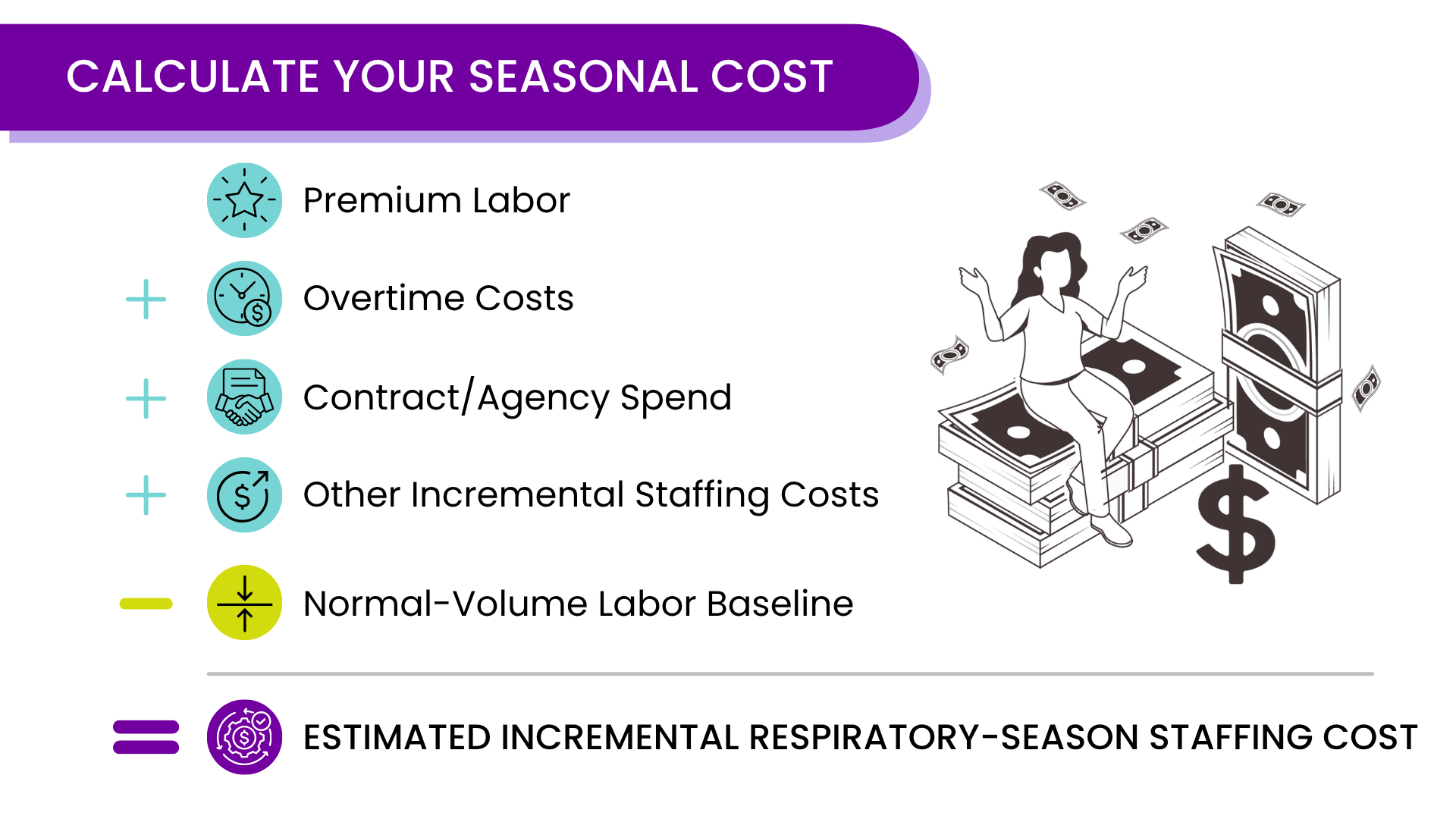
Calculating it is straightforward. Suppose a group of units normally runs $10 million in labor over a comparable period. During last winter's respiratory surge, labor for those same units reached $11.2 million. The $1.2 million gap is your starting point for the incremental staffing cost of the surge.
From there, finance can break the $1.2 million down by source:
How much went to agency or contract labor?
How much came from overtime?
How much came from other premium pay?
How much internal staff or existing capacity could have absorbed?
How much was driven by higher patient volume versus staffing inefficiency?
Aim for a consistent number that finance and operations can use to size seasonal demand and compare it year over year. Consistency is what makes the comparison valid, so the attribution can stay approximate.
Once you've established the number, it carries into this year's budget as your baseline, which the sections below build on.
Turn Last Winter’s Actuals Into a Q4 Plan
Your healthcare labor costs from last winter do their most valuable work in this year's budget. Start with what happened, using six questions:
What did we budget?
What did we spend?
What caused the variance?
Which costs were avoidable?
What level of contingency should we carry this year?
What triggers should activate additional coverage?
The first two questions size the gap, the next two explain what drove it, and the last two convert that into your plan for this winter.
Size the Gap First
Compare your original healthcare staffing budget with actual labor spending during last year's respiratory-season surge. Break down the variance by unit, month, and labor category to see where the additional spend came from.
Not every dollar of that variance should be carried forward. Some costs reflect demand you should expect again. Others reflect gaps in internal capacity, delayed decisions, or coverage that could have been planned differently.
Sort Demand From Response
Sort last year's healthcare labor costs into two groups: the demand you expect to see again, and the spend that came from how your organization responded to it. Not every season costs the same, so the split matters.
Take a unit that reliably runs hotter in late December and early January. Some of that incremental cost belongs in the baseline plan. If the same unit keeps turning to last-minute agency coverage because internal staff weren't reached in time, that premium is an opportunity, not a fixed expense.
Finance and operations should work from the same numbers here. Finance sees where spending exceeded the plan. Operations explains the cause of the coverage gap. Together they decide which costs to budget, which to reduce, and which need a contingency.
Build Coverage in Tiers
Once you know what last winter cost, you can use that number to establish coverage tiers rather than treating the entire season as one staffing scenario. A practical healthcare staffing contingency planning model might look like:
Tier 1: Expected seasonal demand: Cover predictable increases through baseline scheduling, existing staff, and internal float capacity.
Tier 2: Elevated demand: Activate cross-trained staff, PRN clinicians, and additional internal coverage when defined volume or staffing thresholds are reached.
Tier 3: Surge demand: Use pre-planned external coverage when internal capacity is exhausted, with rates and approval requirements established in advance.
Tier 4: Exceptional demand: Define the financial and operational escalation required for a sustained or unusually severe surge.
Thresholds vary by health system, so set yours before demand arrives. Deciding them ahead of time gives your workforce contingency plan defined triggers, expected costs, and clear decision rights.
Put a Cost on Every Tier
Your healthcare workforce surge planning earns its keep when each tier carries a cost. For each coverage tier, estimate:
Number of additional shifts required
Expected internal fill rate
Premium-pay exposure
Overtime exposure
External or agency coverage requirements
Estimated cost per shift
Total incremental labor expense
With costs attached, the planning question sharpens. Each level of demand carries a specific figure: reach this tier, and here's the labor expense that comes with it. For a CFO entering Q4, a demand-linked number like that anchors the budget conversation.
Turn the Analysis Into a Healthcare Labor Budget
Last year's actuals should inform this year's budget without becoming the spending target.
Start with your incremental staffing cost from the previous season, then adjust for expected patient volume, workforce availability, wage rates, internal capacity, and the coverage improvements you'll make before the season begins.
The result is a defensible labor budget that reflects both expected demand and your ability to respond to it. It gives your board and operating leaders a clearer answer to the question they'll ask: what happens if respiratory-season demand runs higher than expected?
With last winter's numbers in your scenarios, you can walk the board through the assumptions behind each level of demand, the cost it entails, and when it’s triggered. The same figure sets your baseline for what you'll spend and when to add coverage, and it points to where exposure can come down.
Cutting Premium Labor Spend During Respiratory Season
Lowering your healthcare labor costs this respiratory season comes down to shifting spend from reactive to planned, and from external to internal.
Internal utilization is the largest opportunity for most organizations. A meaningful share of premium labor covers shifts that existing staff would have taken with better visibility into open needs and a reason to pick them up.
Improving internal fill rates directly reduces overtime and reliance on agencies, and it does so with clinicians who already know your units. The results are measurable. One academic health system used event-level turnover costing to justify a targeted salary investment, then cut its contract-nurse reliance from roughly 1,370 to fewer than 300 and returned turnover to pre-pandemic levels.
Earlier insight compounds the effect. See coverage gaps forming days in advance rather than hours and you fill them at planned rates. The gap between a shift filled with five days' notice and one filled the morning of is substantial, and it repeats across every open shift all season.
Coordination across units matters as much as coordination within them. Surge rarely hits every department at once, so a health system that can move flexible staff toward the units under pressure covers demand it would otherwise pay an outside premium to meet. Strong hospital workforce planning treats internal capacity as the first line of coverage.
Workforce intelligence is what makes each of these practical at scale. A workforce operating system like ShiftMed gives finance and operations a shared view of where gaps are forming and where internal capacity exists to close them, so premium spend stays a choice rather than a default. The platform supports the plan. The plan stays yours.
Each Respiratory Season Sharpens the Next
Respiratory season is predictable in ways that make it manageable, at a cost you've now measured. Finance teams that anchor Q4 healthcare workforce planning to last winter's actual numbers enter the season with a defensible labor budget and a benchmark for comparison. The surprises that used to surface at close show up far less often.
Hospitals and health systems that manage seasonal labor best treat each winter as data for the next. Every season measured makes the next one more predictable and the budget easier to defend. Better workforce decisions build on themselves, and the payoff lands where finance cares most: a stronger operating margin and steadier operations you can forecast with confidence.
Schedule a free workforce consultation to see how much ShiftMed can save you on healthcare labor costs.
Related Healthcare Staffing Articles for CFOs
Healthcare Workforce Analytics: Why CFOs Need to Predict Labor Risk Before Labor Costs Rise
Summer Census Surges: Improving Labor Cost Management and Reducing Traveler Dependence