Nurse Staffing Contingency Plan: From Schedule Build to Hour 0


Somewhere in your health system right now, a nurse manager is building an October schedule against an FTE count set months ago. Respiratory season is coming, and everyone involved knows roughly when it’ll arrive and roughly what it’ll do to the census.
What happens next largely depends on the nurse staffing contingency plan in place: which coverage options are available, when they can be used, and how quickly costs escalate when a gap goes unfilled.
Coverage gaps will open. Some will be visible when the schedule is built, while others will appear through a callout at 6:45 am on a Thursday in January. Nurse leaders will always need a path to follow in all situations.
Most of that readiness is built well before the shift begins. Your workforce plan sets how many options you have and what they cost before you reach for overtime, incentives, travel, or diversion. The opportunity is to see those costs early and plan for the choices that give you more room to act than the staffing report suggests.
Key Takeaways
Staffing gaps become more expensive as shifts get closer and coverage options narrow.
Census alone doesn't tell you whether a unit is adequately staffed.
Float, PRN, and local on-demand clinicians give leaders options before OT, incentives, or contract labor.
Overtime and incentives are only part of the true cost of a staffing gap.
Hospitals can use historical staffing data to prepare for predictable seasonal demand.
Why Nurse Staffing Gaps Aren’t Always Visible in Census Data
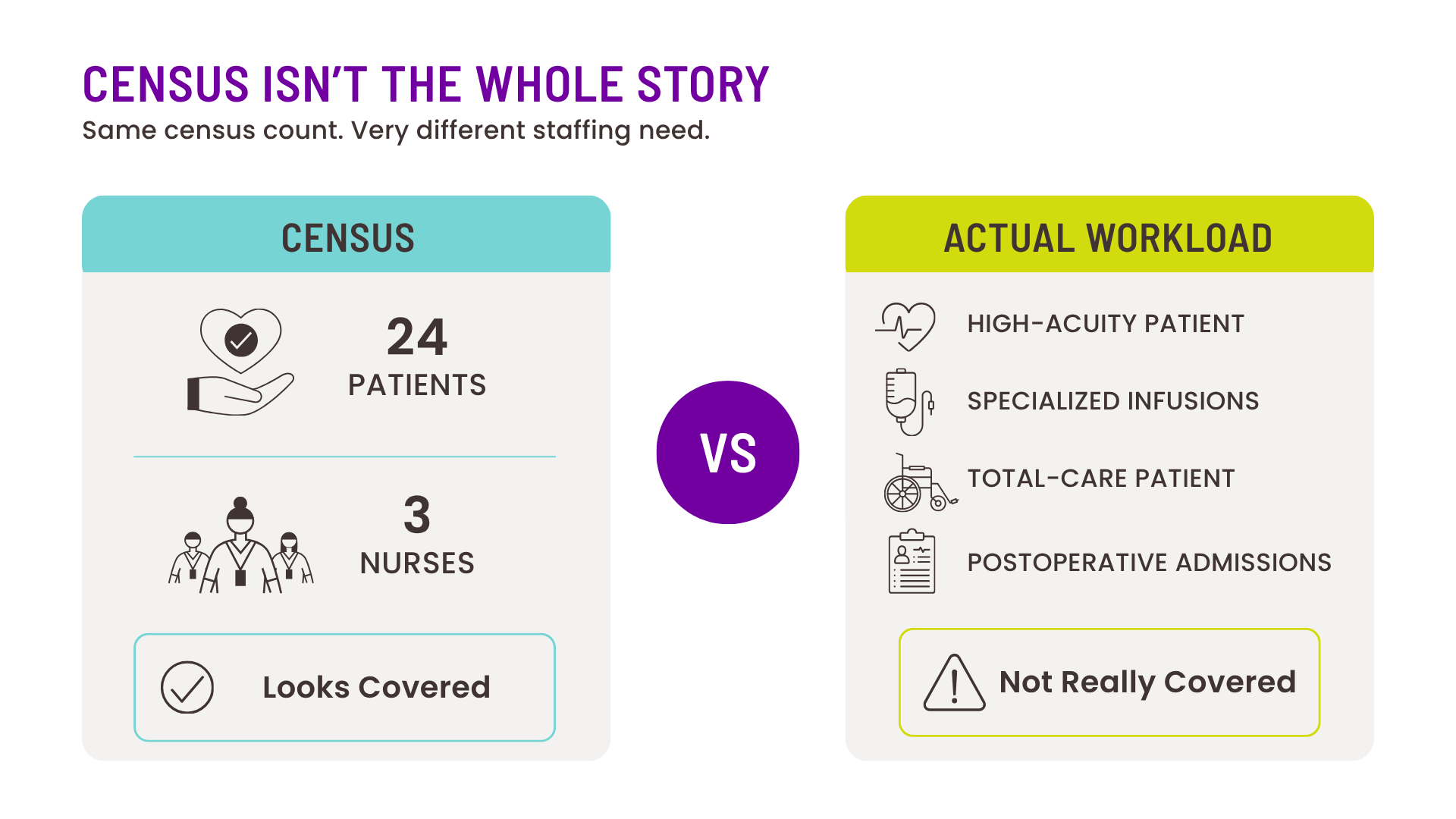
Early in my career, I worked on a med-surg unit where the typical nurse-to-patient ratio was one nurse to nine or 10 patients. Several nurses had gone on maternity leave, and we'd brought in contract staff to cover some gaps. Then came a callout just before the day shift.
At 7 a.m., a quick look at the census made it seem as though we could manage without a replacement. Acuity, however, told a different story. We had a patient with suspected sepsis, several patients with specialized infusions, and a total-care patient who also needed a sitter. The shift report included several expected postoperative admissions. The patient count didn't reflect the incoming workload.
No replacement was available, so the staff on the unit absorbed the additional patients. On paper, the shift was covered. In reality, every nurse was carrying more clinical risk and less time for each patient.
A staffing decision can look sound when it rests on census alone. Acuity, expected admissions, and what each patient needs can change what "fully staffed" means from one hour to the next.
The Lowest-Cost Option for Filling Nurse Staffing Gaps
When a hole appears, we work down a ladder. The order varies by hospital, but you almost always start in the same place: ask the nurses already working to absorb more patients, check other units for a float, have the charge nurse take an assignment, or bring in an internal per diem nurse for the busiest hours.
Those are the first options a manager considers and can often activate without approval. They’re also the least expensive way to close a gap.
When existing nurses absorb more patients, payroll often doesn't move, which is what makes it look free. The cost shows up in workload, missed care, fatigue, and eventually turnover.
Floating a nurse from another unit usually costs the nurse's loaded hourly rate plus any float differential. The hospital must also account for what happens to the unit that gave up the nurse.
When the charge nurse takes patients, the unit loses part of its capacity to manage flow and coordinate admissions and discharges, carrying an operational cost even when it doesn’t appear as a separate expense.
Internal per diem coverage costs the per diem rate plus applicable differentials. Covering the busiest four or six hours is frequently cheaper than bringing someone in for a full 12-hour shift, and it's often the closest match to what the unit needs.
The earlier a gap is identified, the more time the hospital has to use these options before overtime, large incentives, or external labor become necessary.
How Nurse Staffing Costs Rise as a Shift Gets Closer
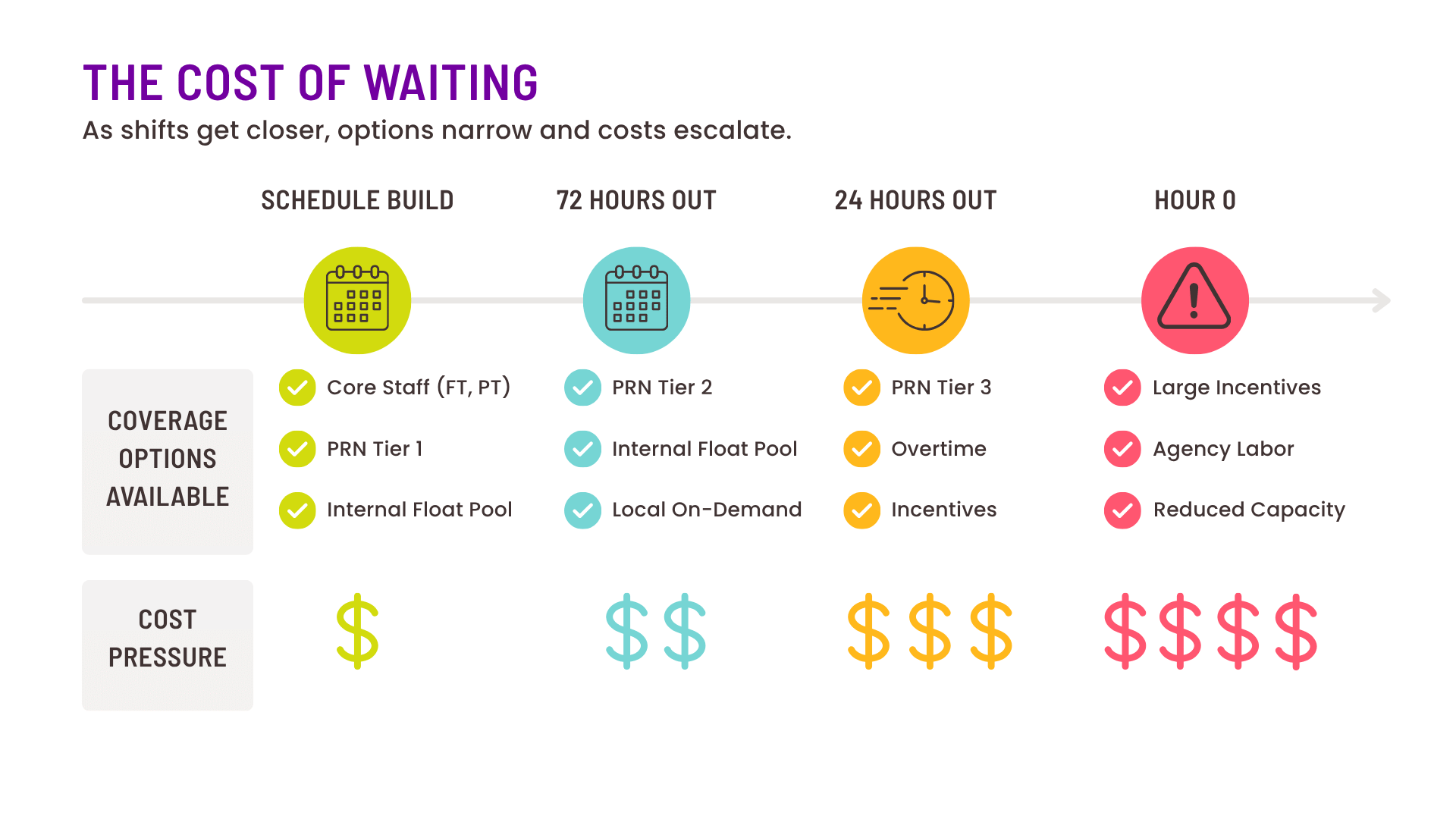
As the start of a shift gets closer, many of the first coverage options may already be exhausted. Then the scenario moves from who’s available to what you’re authorized to pay and who must approve it.
A nurse manager, house supervisor, or central staffing office usually has some room to call staff, approve overtime, or offer incentives within a set limit. Once those run out, higher incentives, external labor, or reduced capacity may need administrative sign-off.
Here’s where the direct labor costs begin to rise. Extended shifts get paid at the regular rate until the nurse hits the overtime threshold, then generally rise to time and a half. Extending a shift solves a few hours of coverage while adding fatigue to the same nurses already picking up the gaps.
On-call activation is rarely just the on-call rate; it can include callback pay, guaranteed minimums, overtime, and differentials. Overtime runs at 1.5x and tends to become a pattern.
The calculation also changes by unit. An operating room missing a circulating RN required for surgery can lose procedural revenue that dwarfs the incentive needed to bring someone in. When an ICU can't safely staff another bed, it must turn patients away. The hospital loses that revenue, and the patient's care gets disrupted.
For respiratory-season planning, reframing matters. The cost of leaving a shift unfilled can be much greater than the hourly cost of bringing in one nurse. Nurse leaders must consider what’s at risk in the specific unit, including procedures, available beds, patient flow, and continuity of care.
The Most Expensive Nurse Staffing Options
At hour 0, you're in the expensive part of the ladder. Large incentives, agency labor at full bill rate with markup, and, at the end of it, diversion or reduced capacity.
Most systems hold off on that last option until nearly everything else has been exhausted, and the reasoning is sound. Once a patient is sent elsewhere, the hospital may lose that admission and the patient's future care. Transfers carry clinical risk, too. A patient may need oxygen during transport, ambulance availability may delay it, and the receiving hospital may be farther from the patient's family.
By that point, the cost is much higher than what it would've taken to bring in one nurse. The right way to price that cost is to compare it against lost contribution margin, the admission or procedure you gave up, and the downstream care that came with it.
The decisions that shape hour 0 often began months earlier or when the schedule was first built. By the time the shift starts, the nurse manager is working with the coverage options the hospital put in place well before that day.
Health systems can often anticipate census patterns and the likelihood that staffing will need to move up or down. August and September are typically high-volume months for labor and delivery, which creates additional demand in the NICU. The pattern is predictable far enough out to plan for it. The respiratory season is at least as predictable.
Many hospitals still staff to a fixed number of budgeted FTEs and per diem positions. When volume rises, they end up paying incentives, overtime, or contract rates to cover a need they had good reason to expect.
Building flexibility into the plan closes that gap, and the demand signal to build it around is already in your data.
Why Hospitals Overuse Nurse Staffing Incentives and Agency Labor
Hospitals often rely too heavily on incentive pay and agency labor. Many open shifts go straight to an incentive or contract staff when an internal float pool, per diem staff, or a local on-demand workforce could have covered them.
Part of that is institutional memory. Many leaders are reluctant to activate per diem coverage because filling a single per diem shift used to require dozens of phone calls, emails, and unanswered messages. Nurse managers remember how much time it took and how unreliable it was, so many systems moved away from it or never built it into their workforce strategy.
Those concerns made sense when the work was manual. A nurse manager no longer has to call or email people one at a time to fill a gap. Shifts can now be identified, routed first to qualified internal staff, then to a local pool of credentialed clinicians through a single workflow, with credentials confirmed and hospital rules applied automatically. Many clinicians want that flexibility and will pick up additional shifts when they can choose where and when they work.
Repeat incentives can also change how nurses respond to open shifts. I once heard about a nurse who declined a shift because she believed the ratios were unsafe and her license could be at risk. When the incentive reached $1,000, she accepted it. The ratio hadn't changed. The assignment hadn't become safer. The money changed her willingness to accept the risk.
I don't blame the nurse. The system taught staff to wait because the payment would likely climb. When incentives become predictable, hospitals can unintentionally create a bidding process for their own shifts. Expensive and hard to reverse. Give managers more coverage options earlier to help avoid that pattern.
The Hidden Costs of Nurse Staffing Gaps
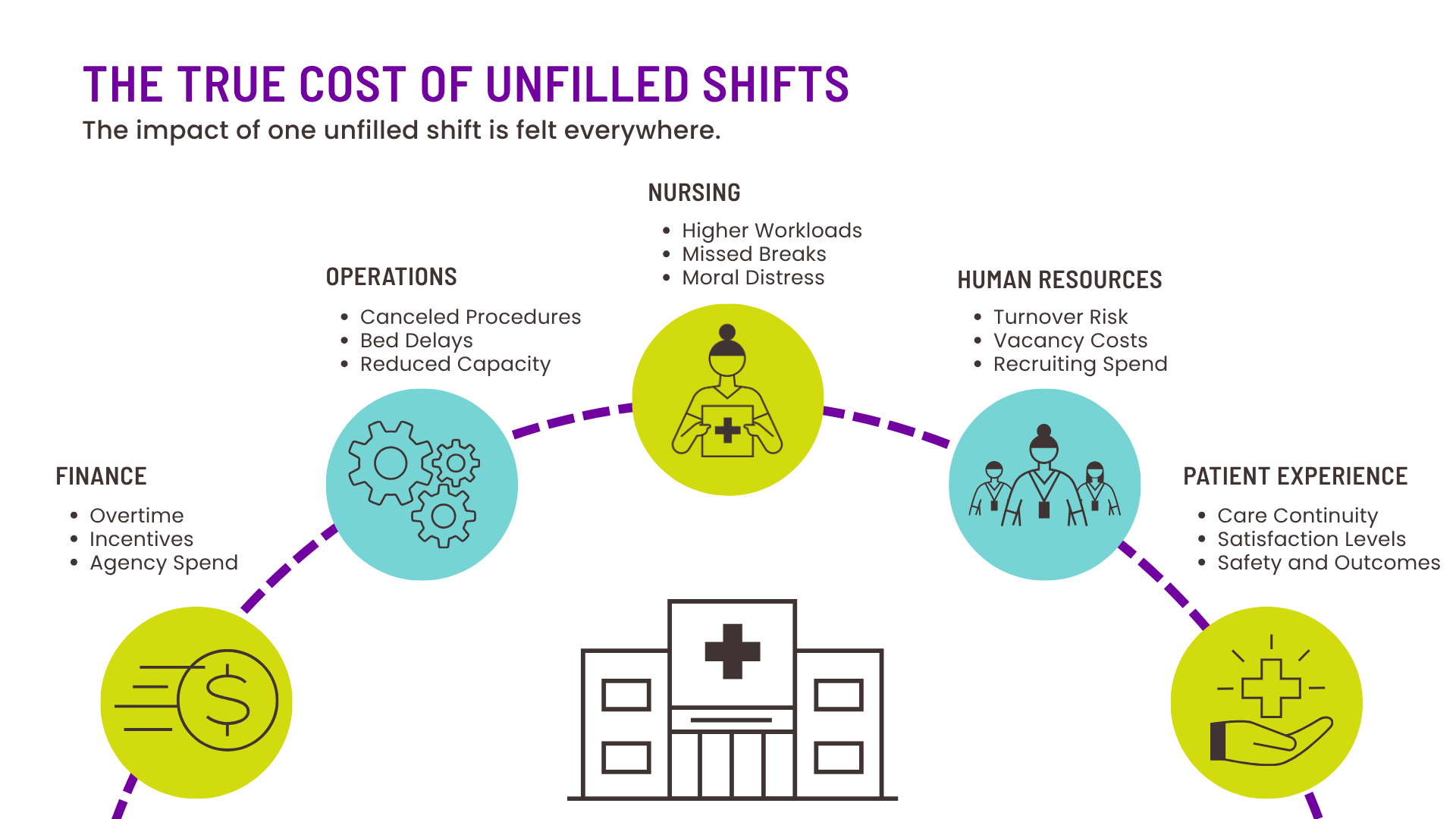
Most of the true cost of an unfilled shift never shows up in the line item where the decision was made. It surfaces later in overtime, turnover, throughput, and patient experience, well removed from the moment the call was made.
Start with the nurse manager's time. I've seen managers spend 40% to 60% of their time on schedules and coverage. These are experienced clinical leaders who should support staff and develop their teams. Instead, they're texting nurses and renegotiating the same gap for the fourth week in a row.
Then there's the load carried by the nurses already on the floor: higher ratios, longer shifts, missed bio breaks, and the steady ask to pick up more hours. Nursing once treated getting through a shift without a lunch break as a badge of honor. Looking back, there was nothing healthy about it, and the people carrying that load are the ones you can least afford to lose.
Turnover carries its own number. The average cost of losing one bedside RN is roughly $60,090, and workload and staffing ratios remain among the top reasons nurses leave. One unfilled shift looks manageable on a report. Repeated often enough, it costs you an experienced nurse.
Canceled procedures and closed capacity add more. There's no single credible average for a cancelled elective surgery, because the impact varies by procedure and payer. The disruption can run into thousands of dollars per hour, and that still doesn't capture the effect on the patient, the surgeon's schedule, or where that patient takes their future care.
Patient outcomes sit underneath all of it. Research consistently links inadequate staffing and nurse burnout with lower patient satisfaction and poorer safety outcomes.
The structural issue is that these costs are distributed. Nursing absorbs the scheduling time. Finance sees overtime and incentives. HR sees the resignation three months later. Operations sees the cancelled case. Until someone puts those numbers side by side, an expensive shift can still look cheap.
When a CNO tells me, "That's not what it costs us," my answer is to look at payroll, turnover, vacancy, patient experience, and lost capacity together, alongside overtime hours, callouts, engagement results, and exit interviews. Labor is one of the largest controllable expenses a hospital has, and it deserves to be measured alongside the others.
How to Build a Nurse Staffing Contingency Plan for Respiratory Season
You don't need new technology to start, and you don't need to wait for a budget cycle.
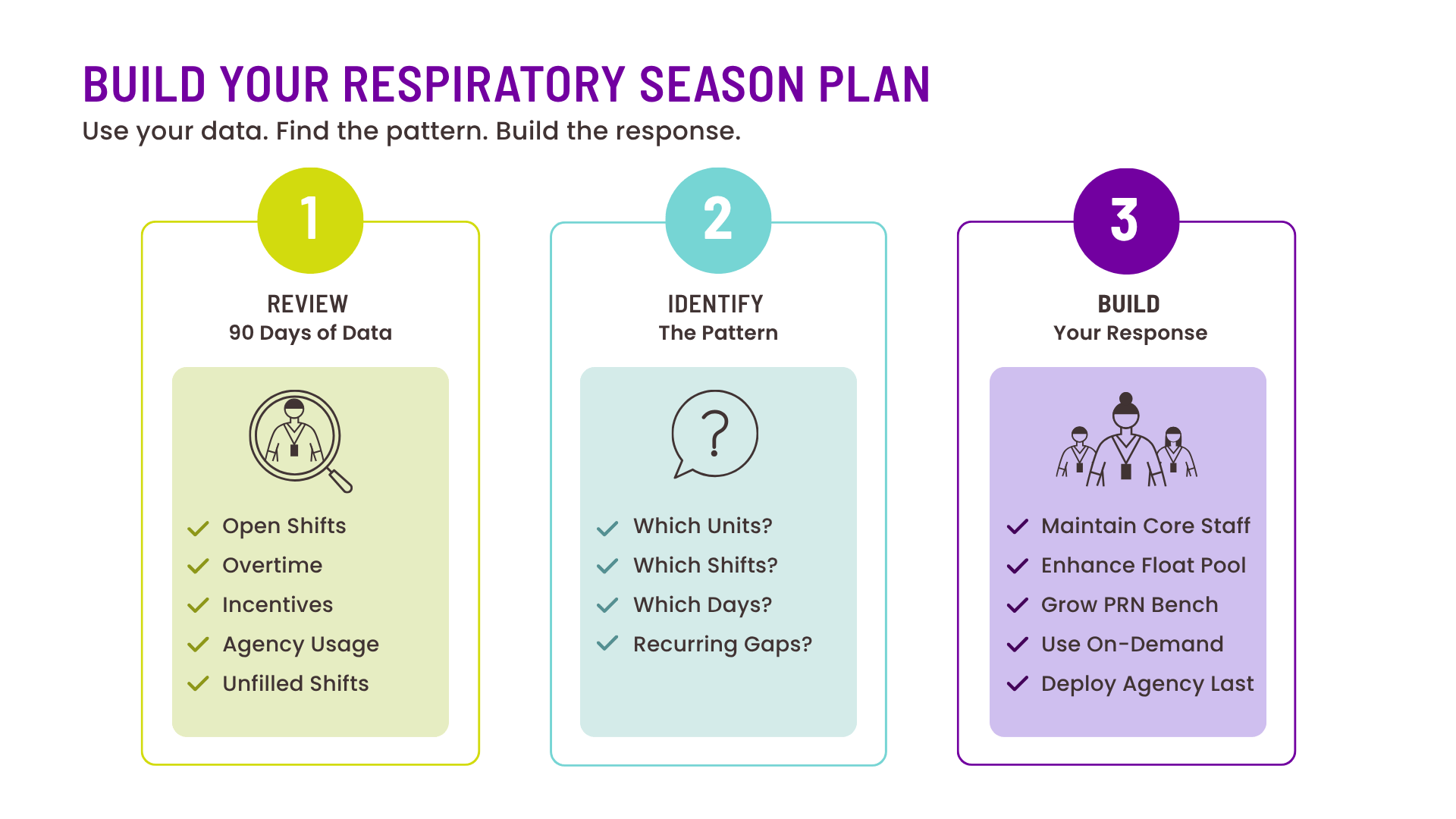
Pull the last 90 days of open shifts, overtime, incentives, agency use, and unfilled coverage, broken out by unit, shift, and day of the week. Then put three things in front of you. Identify which units and shifts consistently produce the same gap. Identify which option is closing those gaps today. Calculate what it would've cost to close them one or two steps earlier.
A single view like that usually makes it obvious which option you're leaning on too hard, and it shows where another layer of coverage would return the most between October and February. Build your nurse staffing contingency plan around the demand you can already see, then bring in technology to make it easier to run and scale.
A strong model has more than one place to go before you reach the expensive end: core FTE staff, internal float pools, internal PRN clinicians, and a local on-demand workforce for the gaps internal options can't cover. Travel clinicians still have a real role for specialized needs and markets without enough local supply. Keep that use targeted, and keep incentive pay targeted, too.
Nurse leaders and staff are responding to the choices before them. The work ahead is to give them more choices before the only ones left are another large incentive or a traveler. Respiratory season won't surprise anyone. The real variable is how many options you've built before it arrives.
See where your staffing costs are escalating.
We can help you analyze your open shifts, overtime, incentives, and agency usage to identify opportunities to reduce labor costs by enabling earlier coverage. Request a free workforce consultation today!
FAQs About Nurse Staffing Contingency Plans
What is a nurse staffing contingency plan?
A nurse staffing contingency plan gives health systems a structured way to respond to unexpected coverage gaps, from internal staffing options and float pools to overtime, incentives, and external labor. The key is knowing which option to use first and how the cost of an unfilled shift can escalate over time.
How much does nurse understaffing cost a hospital?
The cost of nurse understaffing goes beyond overtime and incentive pay. Unfilled shifts can increase workload and burnout, contribute to nurse turnover, and lead to cancelled procedures or reduced capacity. The article notes that losing one bedside RN can cost roughly $60,090, while the financial impact of a cancelled procedure or diverted patient can be significantly higher, depending on the service and payer. The true cost should be evaluated in terms of labor, turnover, patient experience, and lost capacity.
What are the lowest-cost options for filling nursing coverage gaps?
Hospitals typically start with the staffing options they already have, including asking current nurses to absorb additional patients, floating nurses from other units, assigning the charge nurse, or using internal per diem or PRN nurses. These options generally cost less than overtime, incentive pay, or external contract labor. Internal per diem coverage can also be used only during the busiest hours, rather than requiring a full shift.
When should hospitals use internal float or PRN nurses?
Internal float and PRN nurses should be considered early in the staffing contingency process, before hospitals rely on expensive incentives or external labor. Float pools can help move qualified nurses to units experiencing temporary gaps, while PRN nurses can provide targeted coverage when demand increases. Building these options into the staffing plan ahead of predictable periods of higher demand gives managers more flexibility.
How can hospitals reduce nurse overtime and agency costs?
Hospitals can reduce overtime and agency costs by creating more staffing options before a coverage gap becomes urgent. A strong approach includes core FTE staff, internal float pools, internal PRN clinicians, and a local on-demand workforce. Hospitals should also review historical open shifts, overtime, incentive use, agency spending, and unfilled coverage by unit and shift to identify recurring gaps. Addressing those gaps earlier can prevent hospitals from repeatedly relying on premium labor.
How should hospitals prepare for respiratory season staffing needs?
Hospitals should use historical staffing and census data to identify predictable periods of increased demand and build flexibility into their staffing plans before the respiratory season begins. Reviewing the previous 90 days of open shifts, overtime, incentives, agency use, and unfilled coverage can reveal where additional coverage is most needed. The goal is to have multiple staffing options available—such as core staff, float pools, PRN nurses, and local on-demand clinicians—before the hospital reaches the most expensive staffing options.
About the Author
Kelley Strandberg, ShiftMed VP of Nursing and Workforce Innovation, brings a nurse-first perspective to workforce innovation, specializing in helping health systems build more sustainable staffing models and reduce reliance on costly travel labor.
She partners with hospitals and health systems to strengthen operational efficiency through flexible workforce strategies grounded in real clinical and staffing experience.
A former inpatient nurse, Kelley understands the realities of care delivery firsthand. She previously led client solutions at Intellify and held leadership roles at AMN Healthcare focused on per diem, travel, and crisis staffing.
Her work sits at the intersection of clinical insight and workforce strategy, helping nurse leaders build staffing approaches that are practical, scalable, and built for today’s demand pressures.