Healthcare Workforce Analytics: Why CFOs Need to Predict Labor Risk Before Labor Costs Rise


Finance has a clear view of what labor costs were. Each month, your team reviews budget variance, overtime, premium pay, agency utilization, and productivity metrics to understand where performance deviated and why.
However, these reports explain what already happened. They rarely reveal the workforce behaviors creating financial pressure before those costs appear on the income statement.
Knowing where labor dollars went is essential. Knowing where they're headed gives you the ability to intervene earlier, make more informed decisions, and protect margins before costs escalate.
Today’s healthcare environment leaves little room for inefficiency. Reimbursement pressure, shifting care models, rising operating expenses, and higher interest rates continue to challenge financial performance. In this environment, sustainable margin improvement requires greater visibility into the workforce decisions driving future costs.
The next evolution of healthcare workforce analytics is helping CFOs move beyond reporting labor expense to predicting workforce risk, influencing labor decisions, and creating greater financial predictability.
Workforce Analytics Reveal Labor Risk Early
Labor expense is the result of thousands of workforce decisions happening across departments, units, and facilities every day.
A manager approves overtime to cover a callout. A department turns to agency labor because available internal capacity is not visible. A qualified clinician who could fill an open shift is never connected to the opportunity. A float pool remains underused because resources are not coordinated across the organization.
Individually, these decisions may be necessary to maintain operations. Collectively, however, they create the difference between planned labor expense and actual spend.
The challenge for CFOs is that financial reporting captures the impact after those decisions have already been made. By the time overtime, premium labor, or agency costs appear in monthly results, the workforce behaviors driving those expenses have already developed.
Workforce intelligence helps leaders identify the operational signals behind labor expense earlier. By connecting workforce availability, demand, utilization, and performance data, finance and operations teams can recognize emerging cost pressures and take action sooner.
Labor Costs Are Lagging Indicators, Workforce Signals Lead
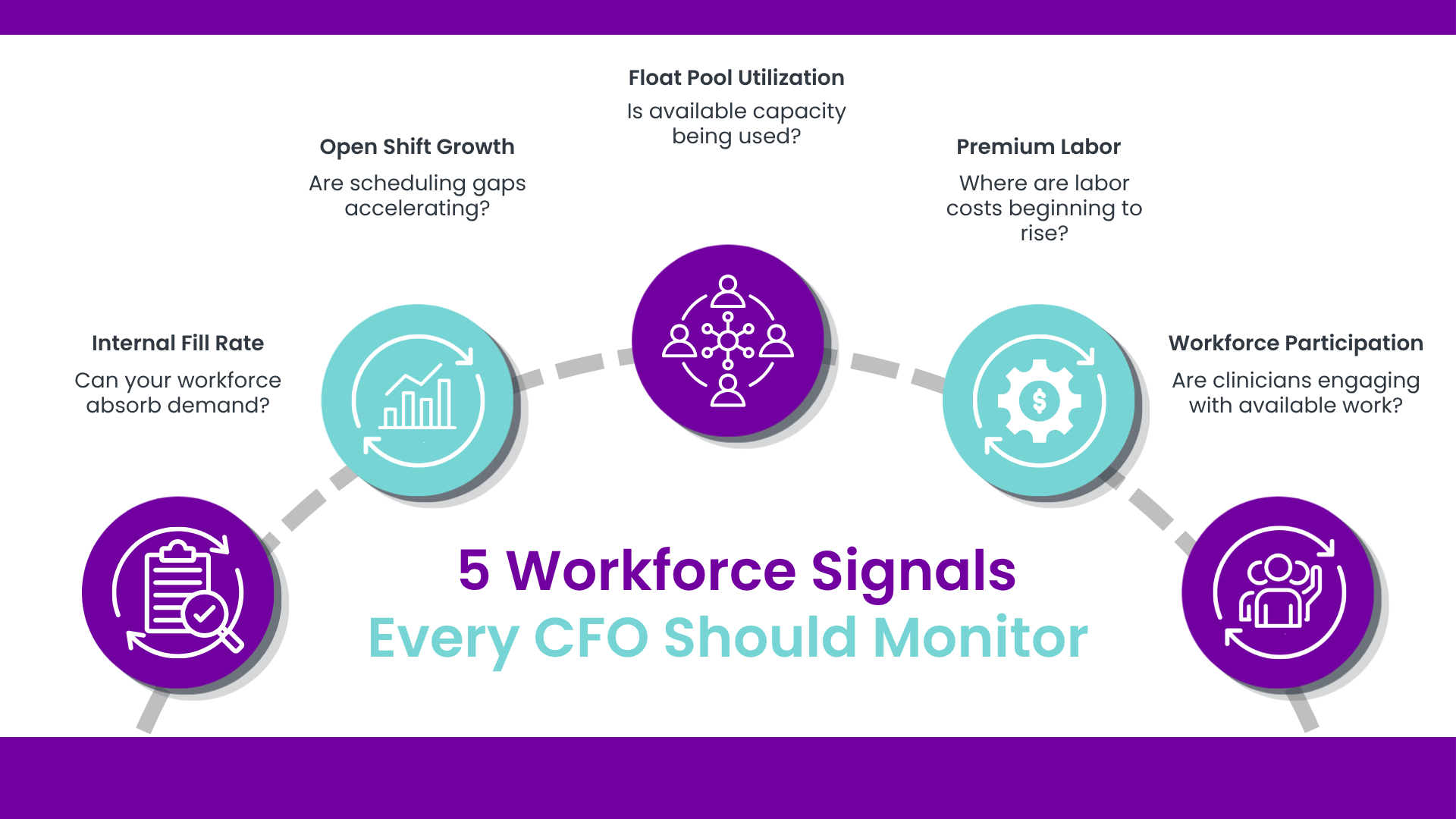
Traditional financial metrics show the outcome of labor decisions. Workforce signals reveal the conditions that are likely to influence future expense.
Changes in workforce behavior can provide early insight into developing cost pressure before it appears in financial results.
Lagging Financial Metrics | Leading Workforce Signals |
|---|---|
Labor Expense Variance | Open Shift Trends |
Agency Spend | Premium Labor Demand |
Overtime Expense | Shift Fill Rates |
Productivity Variance | Workforce Participation Patterns |
Budget Misses | Float Pool Utilization |
By connecting these leading indicators to financial outcomes, CFOs can identify where improvement opportunities exist and make more informed decisions about labor resources. As a result, health systems improve workforce utilization, reduce unnecessary premium labor, and strengthen labor planning.
Moving From Explaining Labor Costs to Influencing Them
Workforce intelligence changes the role finance plays in labor management. Instead of explaining cost variance after it occurs, CFOs can identify the workforce patterns contributing to future expense and determine where action can have the greatest impact.
The conversation shifts:
From: | To: |
|---|---|
Where did labor costs increase? | Where is labor cost pressure beginning to build? |
How much agency labor did we use? | Which areas are becoming more dependent on premium labor? |
What caused this month's variance? | Which workforce patterns are driving recurring cost pressure? |
Why did we miss the forecast? | What actions can improve labor predictability? |
By shifting the conversation, finance leaders move from analyzing labor expense to actively influencing the decisions that create it.
Workforce Coordination Drives Financial Performance
Healthcare leaders have long focused on workforce shortages as a primary driver of rising labor costs. But in many cases, the challenge is less about clinician availability and more about the ability to effectively deploy the workforce already available.
Clinicians increasingly expect flexibility and control over when and where they work. At the same time, many health systems continue to operate with fragmented scheduling processes, disconnected workforce pools, and limited coordination across departments.
This creates a mismatch between workforce supply and operational demand. One area may have available capacity while another relies on overtime or premium labor to fill gaps. Internal resources may exist, but disconnected workflows make it difficult to identify and deploy them efficiently.
For CFOs, this coordination gap represents an opportunity to improve labor efficiency by better aligning workforce capacity with patient demand.
Better Workforce Intelligence Creates Better Financial Control
Effective workforce coordination has a direct impact on financial performance. When leaders understand how labor resources are being utilized, they can make better decisions about where capacity exists and how resources should be deployed.
Rather than addressing labor challenges only after they result in overtime, premium pay, or agency expense, finance and operations teams can identify opportunities to improve efficiency and strengthen workforce utilization.
Better workforce intelligence helps health systems:
Increase utilization of existing clinical capacity.
Reduce reliance on premium labor sources.
Minimize avoidable overtime expense.
Improve labor productivity.
Create more consistent labor planning.
These improvements create a more efficient labor model by helping health systems maximize existing workforce capacity and reduce avoidable dependence on higher-cost labor.
Workforce Intelligence Turns Labor Data Into Financial Insight
The challenge for many health systems is the inability to connect workforce signals across the enterprise quickly enough to influence decisions.
Scheduling activity, workforce availability, labor demand, utilization patterns, and operational performance often exist across separate systems and teams. Without a unified view, leaders are left analyzing disconnected reports rather than understanding the workforce dynamics influencing labor expense.
Workforce intelligence brings these data sources together to reveal the factors shaping labor costs across the organization.
For CFOs, this creates a more complete understanding of where capacity exists, where pressure is developing, and where opportunities exist to improve workforce efficiency.
Looking Beyond Labor Reporting
Financial reporting will always be essential for understanding past performance. But the future of labor management requires health systems to move beyond retrospective analysis and toward predictive workforce intelligence.
Organizations that can identify workforce trends earlier will be better positioned to improve operational agility, protect margins, and make more confident decisions in an increasingly complex healthcare environment.
ShiftMed enables this approach through a dynamic workforce operating system that connects workforce data, predictive insights, scheduling optimization, and enterprise-wide coordination. By providing a unified view of workforce performance, health systems can improve utilization, reduce unnecessary labor expense, and create a more predictable labor model.