How Healthcare Workforce Planning Helps CEOs & COOs Predict Operational Risk


Every health system faces operational risk. The difference is whether leaders can see it early enough to make decisions before it affects performance.
For most organizations, operational risk doesn't appear all at once. It builds through thousands of daily decisions across departments, facilities, and service lines. Overtime increases in one area. Vacancies persist in another. Premium labor rises to fill immediate gaps.
Each decision may solve a short-term challenge. However, when those decisions accumulate without a connected view of workforce performance, they create operational complexity, rising labor costs, and less predictable financial outcomes.
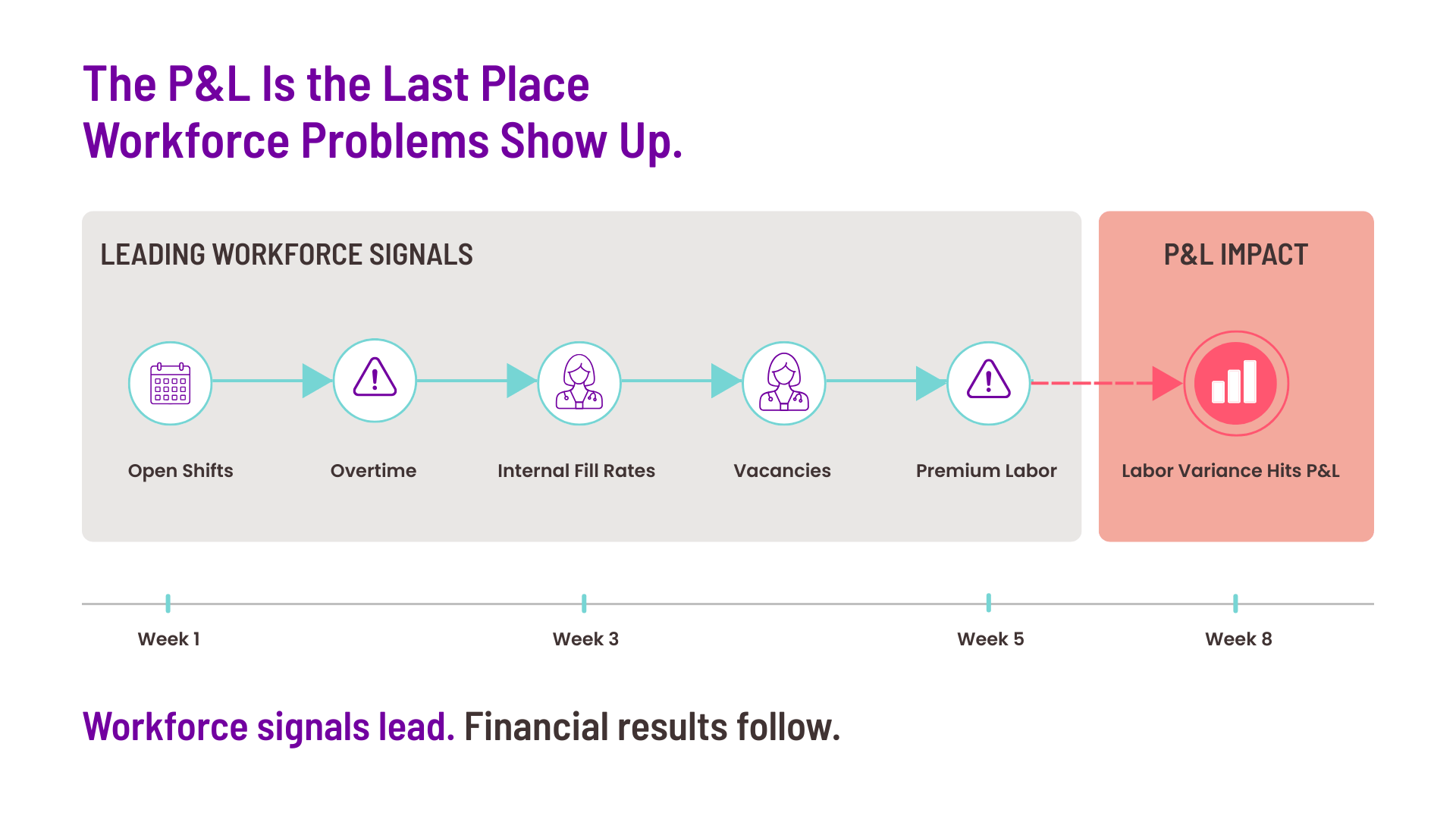
By the time those pressures appear in monthly financial reviews, the underlying workforce trends have often been developing for weeks. That's why healthcare workforce planning is becoming an executive priority rather than a scheduling function.
Traditional Healthcare Workforce Planning Leaves Leaders Reacting
Historically, healthcare workforce planning focused on building schedules and responding to immediate coverage needs. But today’s workforce challenges require a broader view.
Financial metrics remain important, but they often tell leaders what already happened. Labor variance, overtime expense, and premium pay reveal the impact of workforce decisions after those decisions have already shaped performance.
Workforce indicators move earlier. Changes in open shifts, internal fill rates, overtime patterns, vacancies, and workforce utilization can reveal emerging risk before it appears on the P&L. These signals provide leaders with the opportunity to address challenges while options are still available.
The organizations that perform best are moving beyond workforce reporting and toward workforce intelligence, which provides the ability to understand what workforce patterns mean and how they may affect future operations.
The Hidden Cost of Reactive Workforce Decisions
When workforce planning is reactive, the impact extends beyond labor expense.
Premium labor costs are often the most visible consequence, but the operational effects are broader. Managers spend more time filling gaps instead of leading teams. Clinicians experience increased workload pressure, contributing to burnout and retention challenges. Units may limit capacity when workforce availability cannot keep pace with demand.
These challenges often appear separately in executive reviews: labor expense, turnover, productivity, access, and financial performance. In reality, they're connected.
A vacancy may increase overtime. Higher overtime may contribute to burnout. Increased turnover may create additional reliance on external labor. What appears to be an isolated cost issue is often part of a larger workforce pattern.
Without a connected workforce strategy, leaders are left explaining yesterday’s results instead of influencing tomorrow’s outcomes.
Moving from Workforce Data to Workforce Intelligence
Most health systems already have significant workforce data, so the answer isn't more dashboards or reports. The opportunity is connecting that information into a clearer operational view.
Workforce intelligence brings together workforce, operational, and financial signals so leaders can identify patterns instead of reviewing isolated metrics.
Key indicators include:
Internal versus external labor utilization
Overtime trends by department
Open shift demand and internal fill rates
Vacancy and retention trends
Productivity compared with staffing targets
Workforce capacity compared with patient demand
A single metric rarely tells the full story, but patterns do. For example, rising overtime may not indicate immediate risk. But when combined with declining internal fill rates, increasing vacancies, and higher demand, it can become an early warning signal that leaders need to address.
Connected workforce data gives organizations time, which is the most valuable resource when managing operational risk.
Predictive Scheduling Creates Earlier Visibility
Traditional scheduling tools help managers create schedules. Predictive scheduling helps leaders understand where those schedules may break.
By analyzing historical trends, workforce availability, demand patterns, and scheduling behavior, predictive scheduling identifies conditions that commonly lead to coverage challenges. This level of visibility allows leaders to take action before a staffing issue becomes urgent.
So, instead of relying on last-minute solutions, organizations can:
Optimize internal workforce utilization.
Adjust coverage plans earlier.
Identify recurring capacity gaps.
Reduce unnecessary reliance on premium labor.
Better align workforce capacity with patient demand.
While predictive scheduling doesn't eliminate uncertainty, it helps leaders manage it with greater confidence.
Healthcare Workforce Planning Becomes a Strategic Advantage
The most effective workforce strategies connect clinical, operational, and financial decision-making.
Health systems that successfully manage workforce complexity establish consistent measures across facilities, align leaders around shared data, and incorporate workforce performance into broader operational discussions.
This changes the role of workforce management. It moves from a downstream conversation about labor expense to a strategic conversation about growth, access, productivity, and financial sustainability.
For CEOs and COOs, the goal is to understand what's changing, why it matters, and where to act before workforce pressure affects operations.
The Future of Workforce Planning Is Predictive
Workforce performance now influences nearly every major priority in healthcare. Growth depends on workforce capacity. Margin depends on labor productivity. Patient access depends on workforce availability. Operational resilience depends on identifying challenges early.
Healthcare workforce planning gives leaders the visibility needed to move from reaction to foresight. By connecting workforce data, operational insights, and predictive intelligence, health systems can make more informed decisions, improve labor performance, and create a more sustainable operating model.
ShiftMed helps health systems build this connected view of workforce performance across the enterprise, helping leaders identify workforce pressure earlier, optimize available resources, and make decisions before challenges appear in financial results.
In an environment where labor remains the largest controllable operating expense, workforce visibility is now an operating advantage.