Hospital Flu Season Preparedness: The CNO Contingency Checklist


Flu season keeps its own calendar. Some years the peak hits before the holidays, some years it waits until late winter, and it rarely lands where your surge plan assumes it will.
When flu season peaks early, you've got a matter of weeks to line up coverage and walk your charge nurses through a plan they've never run. Some seasons that's just enough time to get everyone in one room.
Flu Season | Peak Week Ending | Peak Weekly Flu Admissions | Total Season Admissions |
|---|---|---|---|
2022-2023 | Dec. 3, 2022 | 26,834 | 230,094 |
2023-2024 | Dec. 30, 2023 | 21,720 | 255,087 |
2024-2025 | Feb. 8 2025 | 55,717 | 560,151 |
2025-2026 | Jan. 3 2026 | 42,625 | 336,361 |
Source: CDC National Healthcare Safety Network (NHSN), Weekly Hospital Respiratory Data (Confirmed influenza admissions reported to CDC NHSN)
The nursing teams that navigate flu season best stay prepared from the start, so when the peak hits, they’re ready. An early jump on the season is what gives you that room. You can lean on your own float, per-diem, and cross-trained staff before you start paying premium rates, and your core team stays steady while the numbers climb.
In this article, you'll see where it pays to spend your time on hospital flu season preparedness in terms of workforce readiness, illness prevention, surge planning, absenteeism contingency, and workforce visibility.
Flu Surge Planning Starts With Knowing What You’ve Got
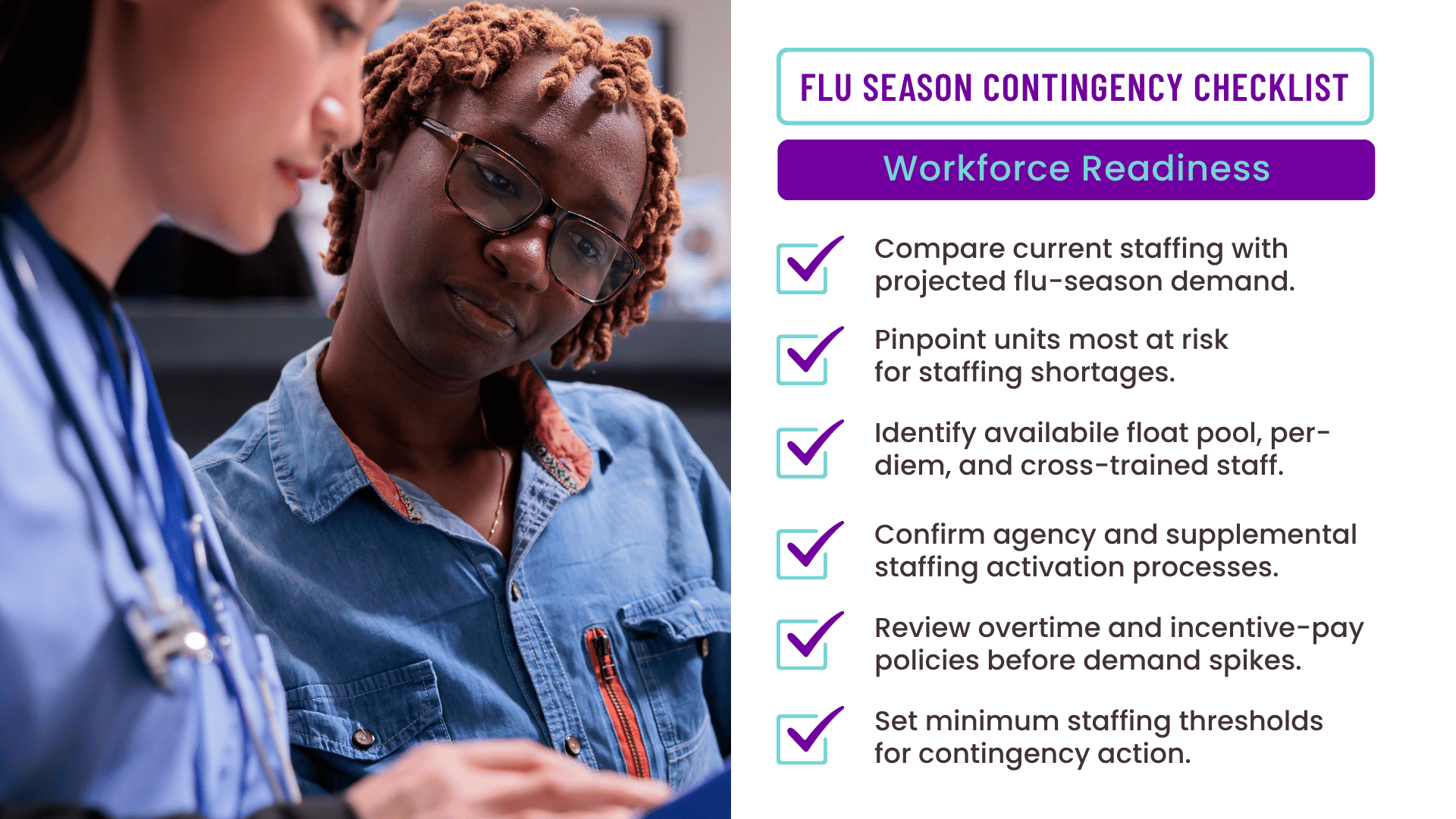
Most of us can name our vulnerable units without looking: the ED, ICU, med-surg, peds, and respiratory. Knowing where pressure will build is the easy part. The real work is understanding how much capacity you have to meet it.
Start with last year’s numbers. Your admission and ED-volume patterns from recent flu seasons can tell you more about what to expect in your own facilities than a regional forecast alone. Compare that projected demand with the beds, clinicians, and coverage you have today. The gaps will become clear.
Then work through your internal workforce capacity. Look at your float pool, per-diem nurses, and clinicians who have been cross-trained. By doing so, you'll know who's available and what they’re qualified to cover. A name on a list doesn’t necessarily mean a nurse who can safely step into your ICU on a Tuesday night.
Once you understand your internal capacity, you can see where supplemental or agency labor may be needed and plan how to activate it before demand peaks. Review your overtime and incentive-pay policies at the same time, so you know what options are available and when you’ll use them.
Early preparation won’t make peak flu season predictable. It gives you more ways to respond when demand shifts. And having options is what helps you avoid making workforce decisions in the middle of a crisis.
Keep Your Employees Healthy With a Flu Vaccination Campaign
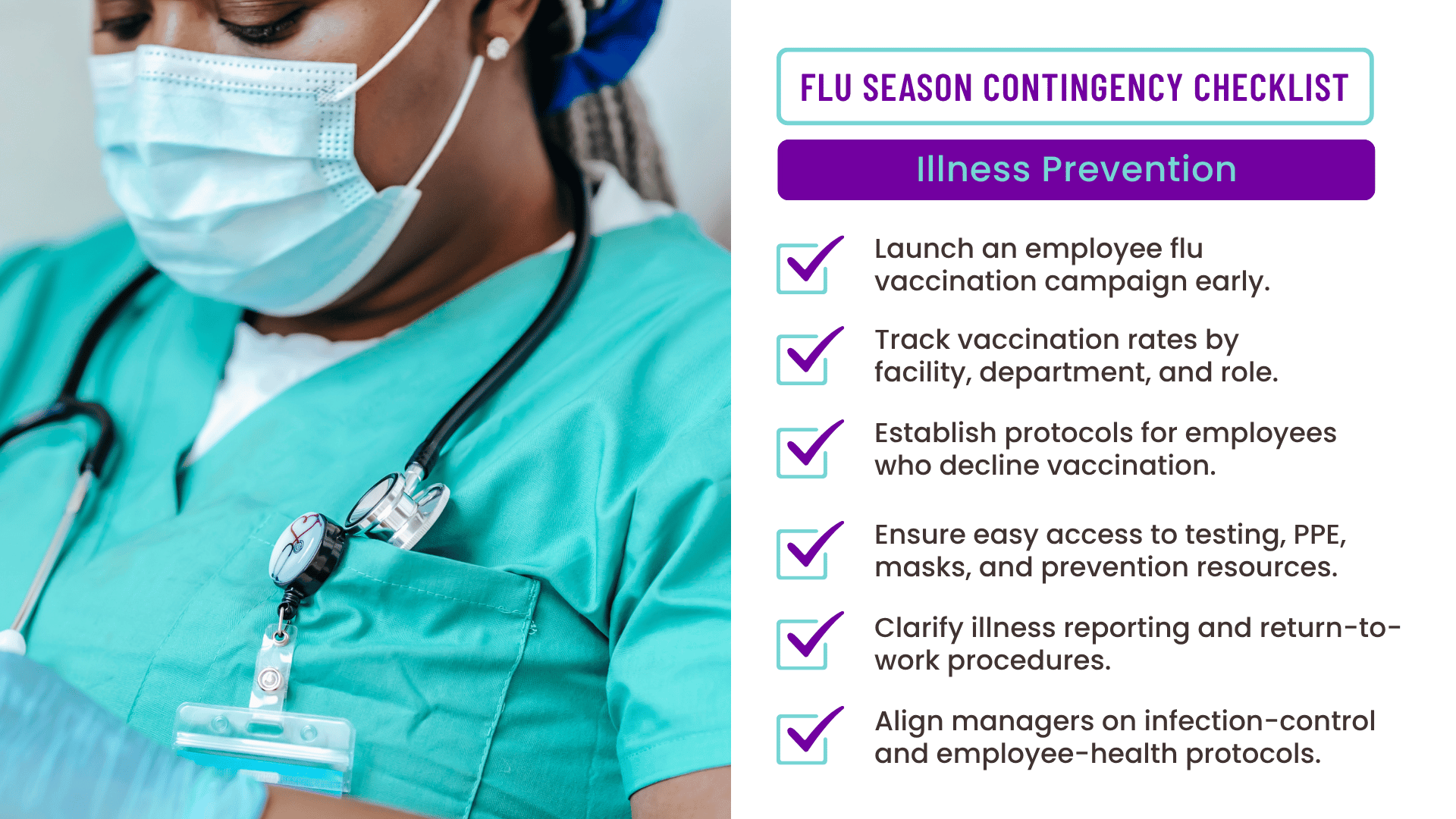
The cheapest coverage you have is the nurse who doesn't get sick. Everything else in your plan works better when fewer of your own people are out.
Get an employee flu vaccination campaign underway early and track your rates by facility, department, and role so you can see where uptake is lagging while there's still time to act. Have a clean protocol ready for the folks who decline, and make sure testing, PPE, and masks are easy to access. When those things are a hassle, people skip them, and that's usually when things spread.
The piece that often gets overlooked is your return-to-work process. When someone can come back and how they clear it has a direct effect on how fast your bench refills. Get your managers aligned on the same infection-control and employee-health protocols ahead of time, so a nurse in one unit isn't getting different answers than a nurse down the hall.
The Nurse Staffing Gaps You Can See Coming
Most staffing gaps don't show up out of nowhere. You can usually see them building a few days out, if you're looking in the right place. The trouble is the information tends to live in three or four different systems, so by the time it lands in a weekly report, the moment to do something about it has passed.
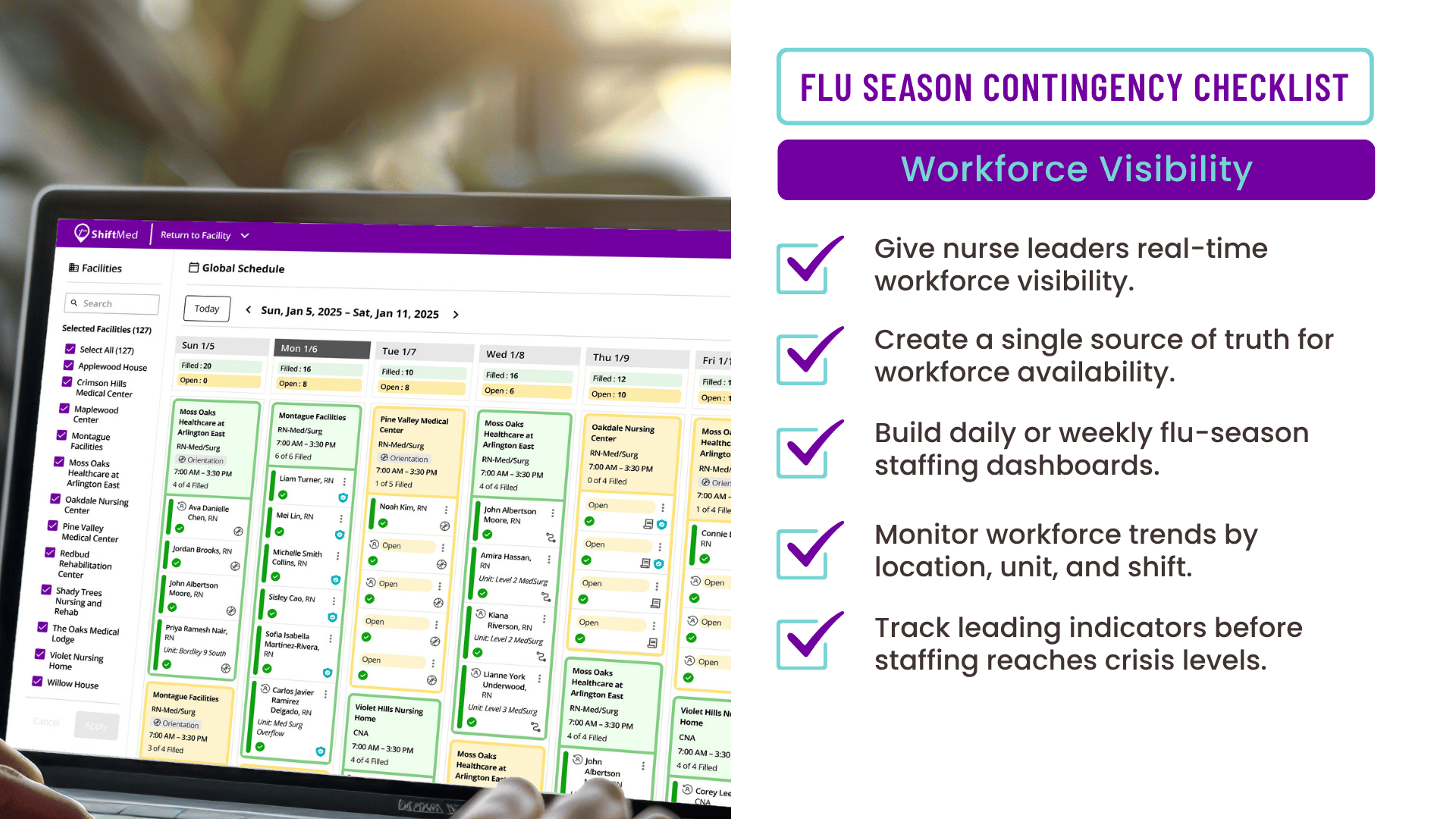
Bringing your nurse workforce data into one view gives your team a clearer picture of what’s happening each day. When staffing levels, open shifts, call-offs, overtime, and agency utilization are visible in the same place, everyone is working from the same information instead of piecing together separate spreadsheets. A healthcare workforce management platform that connects those data sources can make that daily view accessible without someone rebuilding it by hand each morning.
The real value comes from looking beyond organization-wide averages. Break the data down by unit and shift to see where pressure is building. Your overall numbers may look healthy while one unit has been consistently short on nights. Seeing those patterns early gives you more time to move internal resources where they’re needed before turning to agency labor.
Call-offs and rising overtime are often the first signs that a unit is under pressure. Catching those signals early gives you time to move internal resources where they’re needed before turning to higher-cost agency labor.
When Nurse Absenteeism Starts Stacking Up
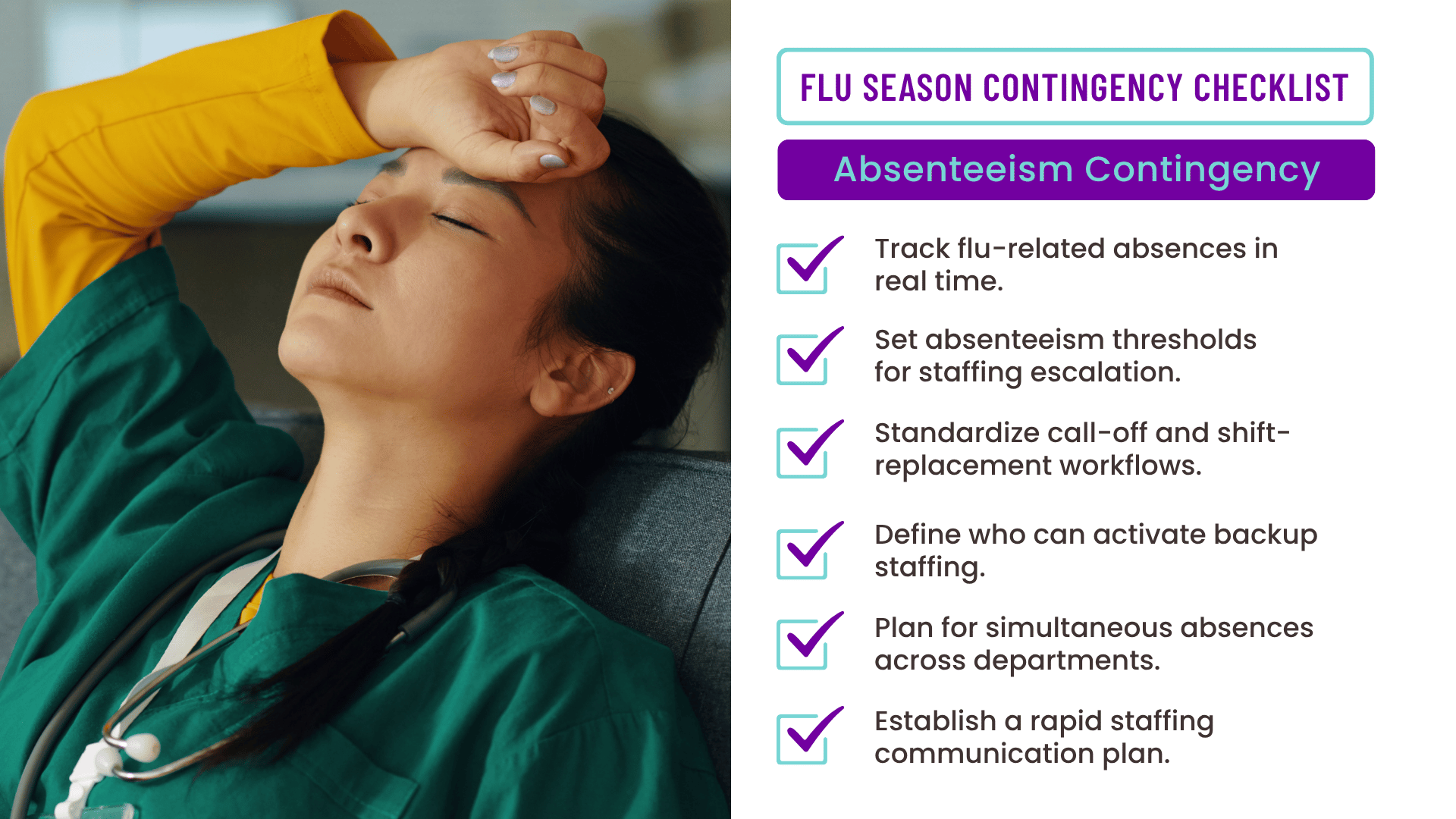
Even with a strong nursing workforce and clear visibility, there will be weeks when absences outpace your available coverage. The key is having a response plan ready before the gaps become urgent.
Decide your thresholds now. What level of absence on a given unit triggers a call for backup, and who has the authority to activate it? When that's clear ahead of time, a charge nurse at 2 a.m. isn't guessing or waiting on a callback. Standardize how call-offs and shift replacements get handled, too, because a consistent process moves faster than a dozen managers each solving it their own way.
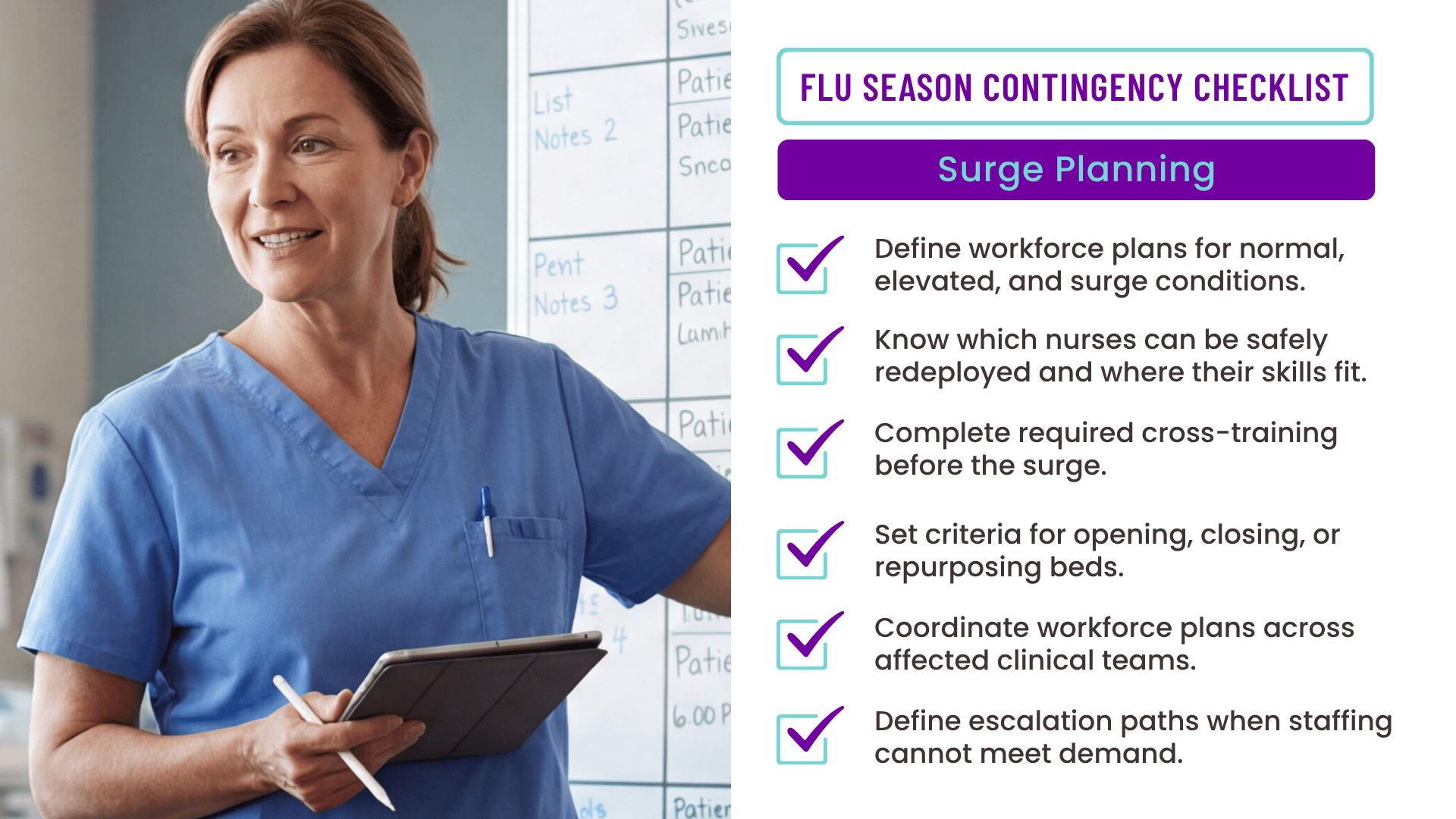
Build surge plans around three levels of demand: normal, elevated, and high. Define the actions for each level so your response can scale as conditions change. Know which nurses can be safely redeployed, where they can work, and what competencies they bring. Complete any needed cross-training before demand rises.
Set clear criteria for opening, closing, or repurposing beds, and align respiratory, EVS, pharmacy, and other support teams around the same thresholds. A bed only creates capacity when the people and services needed to support the patient are ready, too.
Then define the point at which staffing levels can no longer safely support patient volume, along with a clear escalation path to senior leadership. When everyone knows the threshold and who needs to be involved, concerns get raised early enough to act rather than after the team has reached its limit.
Your Flu Season Contingency Plan Comes Down to Who Decides
A good flu season contingency plan falls apart when nobody's sure who owns what. Most of the friction during a hard week comes with who's supposed to make the call.
Assign key workforce decisions to specific people before the season starts. Then, lay out the escalation path so it's obvious who gets pulled in and when. Put a regular check-in on the calendar with nursing leadership, HR, employee health, and infection prevention, so you can compare notes as conditions change, rather than finding out about problems after the fact.
Your frontline managers need something simpler. A short, plain playbook for the disruptions they'll face beats a thick binder nobody opens. Tell your nurses and clinical staff what to expect ahead of time and make sure everyone knows where the current policies and updates are kept, so when things shift, people respond the same way without waiting to be told.
Hospital Flu Season Preparedness Conclusion
Flu season tends to go better for the hospitals that prepare before the pressure arrives. The strongest teams know their capacity, recognize the early signs of rising demand, and have a clear plan for how they’ll respond. Greater visibility into your nursing workforce, paired with coordination ahead of the surge, gives you more options when volume rises and helps your team navigate the season with greater control.