How CNOs Can Predict Workforce Strain Before It Impacts Nurses and Patients


A last-minute callout isn't the start of a staffing crisis. It's the moment the crisis becomes visible.
It begins with a conversation no CNO wants to have. A nurse manager calls with news that another team member has called out, and the unit is already running at its limits. Overtime is climbing, and the same experienced nurses are being asked to step in again because they’re the ones everyone trusts to keep things moving.
On paper, everything seems under control. Vacancy rates are manageable, turnover hasn’t increased, and staffing reports don’t signal immediate concern. But those numbers don’t always capture what teams are experiencing daily or the strain that’s growing beneath the surface.
Workforce strain rarely appears overnight. It builds through higher workload demands, schedule instability, reliance on key team members, and subtle changes in the clinician experience. By the time the impact appears in traditional metrics, CNOs are responding to a problem that’s been developing over weeks or months.
Predictive workforce analytics offers a proactive approach by identifying early signals of workforce strain, clinician burnout, and risks to patient care. With earlier visibility, CNOs can intervene sooner, better support their teams, and make more informed workforce decisions.
The Problem With Waiting for Traditional Workforce Metrics
Many of the workforce measures nurse leaders rely on, including turnover, vacancies and agency use, confirm a problem after it has already been developing. By the time these metrics change, leaders are already managing the impact on their teams.
The warning signs of workforce strain include escalating incentives, returning sign-on bonuses, and expanding retention efforts. Eventually, leaders turn to travelers and premium labor to fill gaps that developed before they surfaced in a workforce report.
The cost of reacting late extends far beyond the budget. Sustained workforce strain affects clinician well-being, increases the risk of missed details, and places additional pressure on the nurses who continue showing up to provide safe, compassionate care.
I’ve seen the impact of workforce strain firsthand. Someone close to me woke from a medically induced coma after more than two weeks. During a cognitive assessment, the nurse documented confusion because the patient couldn’t name the current day. She didn’t account for the fact that the individual had been unconscious for an extended period.
The nurse wasn’t inexperienced or careless. As it turns out, she was a dedicated clinician who’d been working significant overtime and covering every weekend for six consecutive weeks. The reality is that even the strongest nurses are vulnerable when they’re consistently asked to carry more than a sustainable workload allows.
Research supports what many nurses experience. One analysis of more than 11,000 nurses found that medication errors were 28% more common among those working over 40 hours per week, with overtime hours raising error risk by 30% (Olds & Clarke, Journal of Safety Research). Fatigue doesn't discriminate by skill or dedication; it erodes the margin for error in everyone.
Health systems can’t afford to wait for workforce strain to show up in traditional metrics. Nurse leaders need earlier visibility into risk signals so they can intervene before strain affects clinicians, staffing stability, and patient care. That’s where predictive workforce analytics comes in.
Workforce Strain Begins Long Before Burnout Is Visible
A filled schedule can create the illusion of stability while masking an unsustainable workload.
I think about an experienced oncology nurse I knew who joined a new hospital and quickly became the person everyone relied on. Because of her expertise, she was repeatedly assigned to multiple patients requiring chemotherapy, blood transfusions, and other treatments that demanded close monitoring.
Her patient count looked reasonable on paper. But in reality, she was managing high-risk medications, watching for infusion and transfusion reactions, assessing central lines, tracking changing symptoms, and supporting families through some of the hardest days of their lives.
Within two months, she was burned out and looking for another job. The schedule showed her unit was staffed, but it never showed the weight she was carrying.
The overuse of trusted clinicians is one of the most concerning patterns I see in nursing today. It’s always the same nurses picking up extra shifts, floating without complaint, and absorbing higher-acuity assignments. Because these nurses rarely say no, managers often rely on them without fully understanding the workload they carry, which puts them at greater risk for burnout.
Predictive Workforce Analytics Reveal What Traditional Reporting Misses
Nurse leaders need visibility into more than who’s scheduled. They need to know who’s carrying the greatest workload, where fatigue risk is building, and how staffing decisions align with compliance requirements and qualifications. Today, that full picture is often difficult to access.
Most workforce information lives in different systems, in spreadsheets, or in the head of an experienced staffing leader. Fragmentation like this creates enormous manual work and makes it nearly impossible to apply staffing rules consistently.
Predictive workforce analytics gives a clearer view of workforce health by combining schedules, clinician workload, availability, compliance requirements in one place. It identifies where teams are approaching capacity limits so leaders can intervene before fatigue, burnout, or coverage gaps occur.
The conversation changes from Who can cover this shift? to Where is workforce strain building, and how do we address it before it impacts nurses and patients?
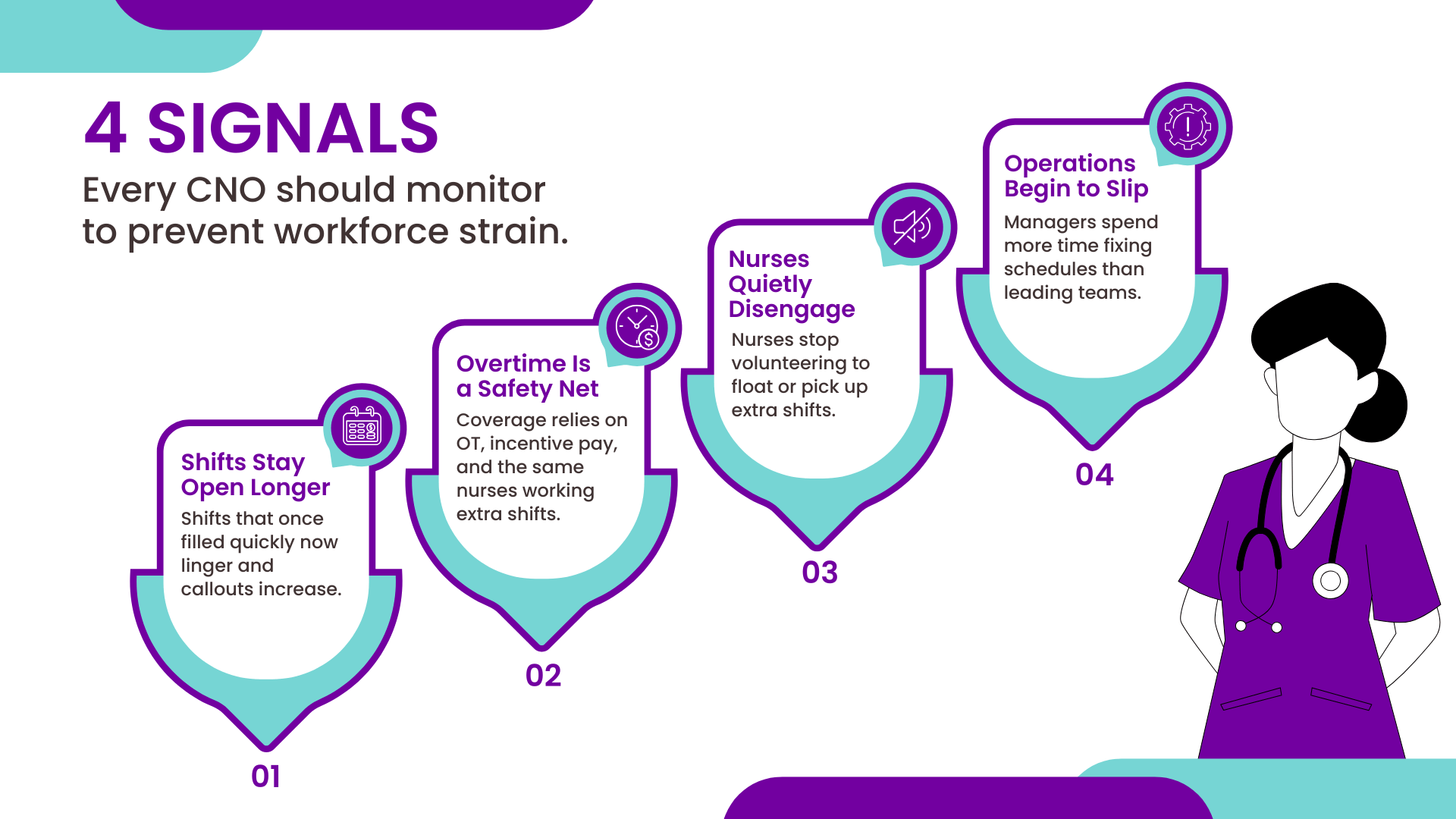
4 Workforce Signals Every CNO Should Monitor
While nurse turnover is an important workforce metric, it's a lagging indicator. By the time a nurse resigns, the conditions driving that decision have been building for months.
Predictive workforce analytics helps CNOs identify the early signals of workforce strain before they become turnover and operational disruption.
1. Open shifts take longer to fill.
When shifts that were once covered quickly begin sitting open longer, it signals that workforce flexibility is narrowing. Increasing callouts and fewer available clinicians can indicate that a unit’s capacity to absorb disruption is under pressure.
2. Overtime becomes the safety net.
When coverage increasingly relies on overtime, incentive pay, or the same dependable nurses repeatedly stepping in, the workforce may be operating beyond a sustainable pace.
3. Clinician participation begins to decline.
A drop in nurses volunteering to float, pick up additional shifts, or participate in flexible scheduling can be an early sign of fatigue, disengagement, or growing workload concerns.
4. Operations friction starts to increase.
When managers spend more time rebuilding schedules, resolving coverage gaps, or reacting to daily disruptions, it’s a sign the workforce model may be compensating for underlying strain rather than proactively managing demand.
Turning Workforce Insights Into Early Action
In my experience, the warning signs are visible as soon as a schedule is built. Limited coverage, an uneven skill mix, repeated reliance on the same nurses, and little flexibility to absorb changes in census all signal that a unit is operating with very little margin for error. The staffing gap may still be weeks away, but the risk is already there.
Recognizing the risk is only the first step. Workforce intelligence helps leaders connect these signals, identify where strain is building, and act before challenges escalate. So, instead of relying on manual reviews and fragmented data, technology can help teams identify emerging strains and act before a gap becomes a crisis.
With the right AI-powered workforce operating system, nurse leaders can apply overtime limits, follow collective bargaining rules, account for qualifications and fatigue, and route open shifts based on skills, fairness, cost, and organizational priorities.
ShiftMed, for example, brings internal staff, float pools, RN resources, and local on-demand clinicians into a single workflow while applying health system rules for qualifications, fatigue, fairness, and cost. Leaders gain a coordinated workforce strategy without having to build the infrastructure themselves.
Technology should handle the coordination, not make clinical decisions. Leaders still know their units, patients, and people best. The role of technology is to eliminate hours spent reviewing spreadsheets, making phone calls, and trying to remember every workforce rule.
As one chief nursing officer shared at a conference I recently attended, “AI isn’t going to take your job, but people who don’t learn to use it may eventually be replaced by those who do.” There’s truth in that. The health systems learning to use AI now are already ahead of those still relying on manual efforts. As their AI fluency grows, these systems will be better equipped to anticipate workforce strain and respond accordingly.
Building a More Resilient Workforce with Predictive Decision-Making
Some health systems are already building the workforce models that others will spend years trying to replicate. These forward-thinking systems don’t treat flexibility as a last-minute solution. They build strong internal float pools, create fair shift allocation processes, and give clinicians more control over when and where they work.
These health systems prioritize their own workforce, then strategically leverage qualified local clinicians when needed. They also use operational intelligence to reduce manual staffing work, replacing hours of calls, texts, and spreadsheets with data-driven decisions. As a result, they have a highly resilient workforce that can flex without overburdening the same nurses, increasing administrative workload, or compromising fairness, skill mix, or patient safety.
The healthcare organizations that continue to rely on reactive staffing models will spend the next five years responding to problems their peers have already learned to anticipate.
Moving from Reactive Staffing to Predictive Workforce Leadership
If I could offer every clinical leader one piece of advice, it would be to stop trying to recruit harder into the same workforce model.
The healthcare industry has spent years increasing bonuses, expanding incentives, and intensifying recruiting efforts, yet many organizations are still trying to solve the same staffing challenges the same way.
Workforce models must change. What worked a few years ago no longer meets today’s reality. Clinicians need more flexibility, leaders need better visibility, and health systems must be able to adapt without repeatedly relying on the same people.
Predictive workforce analytics helps make that possible by providing a clearer view of the workforce, earlier signals of strain, and the insight to act before a staffing crisis emerges. A crisis is far easier to prevent when the workforce is built to flex before the callout ever happens.
About the Author
Kelley Strandberg, ShiftMed VP of Nursing and Workforce Innovation, brings a nurse-first perspective to workforce innovation, specializing in helping health systems build more sustainable staffing models and reduce reliance on costly travel labor.
She partners with hospitals and health systems to strengthen operational efficiency through flexible workforce strategies grounded in real clinical and staffing experience.
A former inpatient nurse, Kelley understands the realities of care delivery firsthand. She previously led client solutions at Intellify and held leadership roles at AMN Healthcare focused on per diem, travel, and crisis staffing.
Her work sits at the intersection of clinical insight and workforce strategy, helping nurse leaders build staffing approaches that are practical, scalable, and built for today’s demand pressures.