Holiday Scheduling for Nurses: A COO's Playbook for Operational Readiness


Every holiday season tests a hospital's operating model. Elective volume may dip, but emergency demand, respiratory illness, and post-holiday admissions continue to move. At the same time, PTO requests peak and callouts become harder to predict.
For many health systems, holiday scheduling for nurses still starts in a spreadsheet and ends in a scramble. Open shifts surface late. Managers reach for overtime and incentive pay. Agency requests go out when options are thinnest. The impact reaches well beyond nursing: into the ED, discharge timing, and the labor budget.
COOs can get ahead of holiday coverage by forecasting demand, identifying gaps before finalizing schedules, and setting clear rules for filling open shifts. A flexible workforce helps health systems put that plan into action and maintain coverage through the holidays.
Why Holiday Scheduling for Nurses Is an Operations Issue
Open holiday shifts affect more than the unit left short. Med-surg gaps can delay ED transfers and discharges, leave staffed beds unused, and force procedural areas to postpone cases. Staffing gaps quickly become throughput and capacity problems.
Late coverage decisions also increase labor costs. Overtime, incentive pay, and agency nurses help fill gaps, but relying on them as the default response can push labor costs beyond budget and productivity targets. When PTO requests, callouts, and census spikes coincide, the impact grows.
Limited visibility makes the problem worse. When units manage holiday schedules in separate spreadsheets with different rules, leaders may not see coverage gaps until the shift is already short. By then, lower-cost options may be gone.

Forecast Demand and Find Coverage Gaps Before Finalizing Schedules
Start holiday workforce planning two to three months ahead. Forecast demand to identify coverage gaps before schedules are final and managers must react.
Build your forecast around:
Historical census and acuity for the same holiday weeks, by unit and campus.
Approved and pending PTO, plus known leaves of absence.
Historical holiday call-out rates.
Planned procedure volumes and unit consolidations.
Use the forecast to map coverage risks by unit, date, and shift. Managers can then address gaps early, starting with the most appropriate coverage option rather than defaulting to the fastest and often most expensive solution.
Plan Holiday Shift Coverage Early to Limit Avoidable Premium Labor
Early planning gives leaders more options to control holiday labor costs. Census spikes, respiratory season, and holiday demand can still drive premium labor, but identifying gaps weeks in advance gives managers time to find alternatives before expensive last-minute coverage becomes necessary.
Set premium labor rules before the holidays:
Standardize incentive pay. Set system-wide criteria instead of approving rates on a shift-by-shift basis.
Define overtime approvals. Establish when overtime is appropriate and who authorizes it.
Set agency thresholds. Determine when agency coverage is justified and who approves its use.
Review costs weekly. Track premium labor by unit throughout the holiday season and address rising costs before they exceed budget.
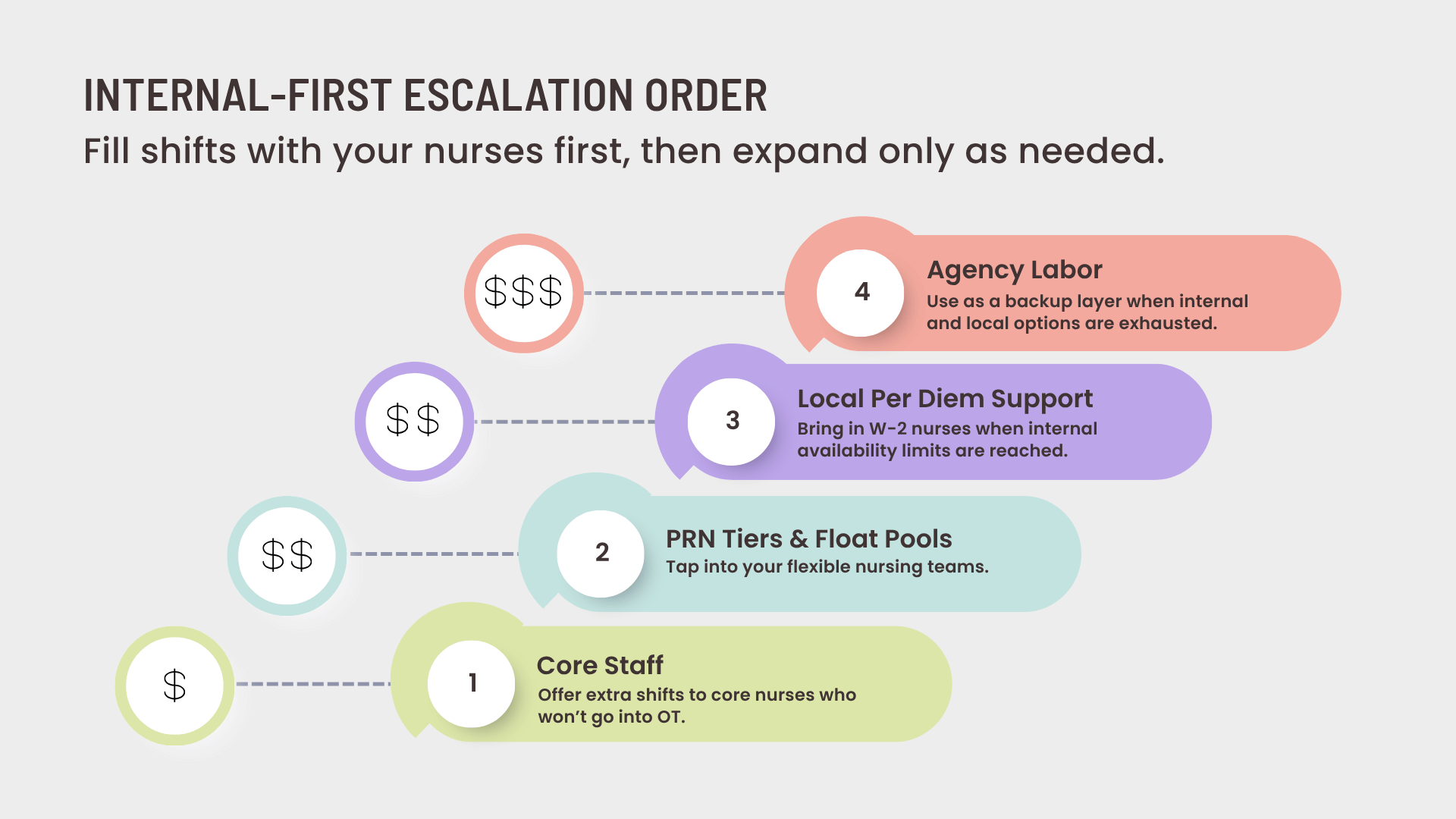
Offer Shifts Internally Before Escalating to External Labor
Many hospitals have more holiday capacity than their schedules suggest. Part-time nurses may want extra hours. Staff on other units may be willing to pick up a shift close to home. Without a consistent way to surface those options, managers default to overtime or agency because they know it will work.
A clear escalation path helps. The exact order will vary, but a typical sequence looks like this:
Self-scheduling and nurse shift swaps within the unit, using clear approval rules.
Float pool staffing, deployed against the gap map rather than first-come, first-served.
Internal PRN staff and local per diem clinicians.
Voluntary overtime, within fatigue limits.
Incentive pay for hard-to-fill shifts.
Agency staffing for remaining critical gaps.

Coordinate Across units, Campuses, and Service Lines
Holiday staffing suffers when units follow different rules. One campus posts shifts weeks ahead while another waits until the day before. One manager approves overtime; another turns to agency nurses. These inconsistencies limit visibility, drive up costs, and make it harder to shift resources where they’re needed.
Standardize holiday scheduling across every campus. Set rules for when open shifts are posted, who can claim them and who approves overtime, incentive pay, and agency requests. Define who can authorize unit consolidations when census drops.
During peak holiday weeks, hold brief daily staffing huddles with nursing leaders, house supervisors, the emergency department, and case managers. Review coverage gaps, census changes, and patient flow to coordinate decisions across the hospital.
Prepare for Cancellations, Callouts, and Fatigue
Last-minute changes are inevitable, even with strong holiday planning. Establish a clear backfill process for callouts and consistent low-census and cancellation rules so managers can adjust coverage fairly in either direction.
Protect nurse well-being by setting limits on overtime and distributing holiday obligations fairly. Build these safeguards into your plan:
Cap consecutive shifts and weekly overtime hours.
Rotate major holiday assignments fairly each year.
Publish schedules early so nurses can plan their holidays.
Fair, predictable schedules support nurse retention. How leaders manage holiday coverage can affect engagement well into the new year.
How a Flexible Workforce Strengthens Holiday Shift Coverage
A fixed staffing plan can’t account for every change in census, acuity, or callouts. ShiftMed gives COOs a flexible way to respond to coverage gaps while controlling labor costs and protecting patient flow.
Fill gaps locally: Access qualified, credentialed clinicians to cover open shifts and maintain unit capacity.
Match coverage to demand: Adjust staffing as census and acuity change.
Standardize scheduling: Give every unit and campus one consistent process for posting and filling open shifts.
Identify gaps earlier: Use real-time workforce data to spot coverage risks before they disrupt operations.
Reduce premium labor costs: Fill gaps through flexible coverage options before turning to overtime and incentive pay.
Make Holiday Scheduling a Readiness Plan
Holiday scheduling for nurses will always involve hard trade-offs. But it doesn't have to be a scramble. When COOs treat it as an operational readiness plan, built on early forecasting, consistent escalation rules, clear decision ownership, and a flexible workforce, leaders gain the visibility to make better decisions and more opportunities to avoid unnecessary premium labor.
The result is steadier coverage, smoother patient flow, and a holiday season your teams can plan around.
Ready to build more flexibility into your holiday staffing plan? Talk with ShiftMed about keeping units open and shifts covered this season.