How to Use Nurse Overtime to Predict and Prevent Workforce Misalignment


Nurse overtime isn’t just a line on the budget; it tells a story about how your workforce is really functioning. Hospitals often react to overtime after the fact, scrambling to cover shifts or pay premiums. But those extra hours reveal deeper issues: scheduling gaps, uneven skill distribution, and operational inefficiencies that quietly put patients and nurses at risk.
A 2025 national survey by Black Book Research found that 92% of nurses reported that charting and documentation negatively impact their job satisfaction, with many stating that it takes up to 40% of their shift. When nurses spend nearly half their time on documentation, overtime spikes and so does burnout.
The good news? Hospitals can use overtime as an early-warning sign to prevent workforce misalignment. With predictive scheduling and shift-level analytics, hospitals can anticipate gaps before they become costly overtime, keeping nurses supported, patients safe, and budgets under control.
Why Overtime Is a Leading Indicator of Workforce Misalignment
Overtime often gets blamed on poor scheduling, and it’s easy to see why. Schedules are visible—posted weeks in advance, showing who’s working which shift—while overtime shows up as “extra” hours on top of that plan. So, when overtime spikes, the first instinct is to point at the schedule.
It also feels controllable. Leaders and managers often think, “If only the schedule were better, this wouldn’t have happen.” But the reality is usually more complex. Overtime is often the result of unplanned call-outs, patient surges, uneven skill mix, or nurses spending excessive time on administrative tasks. Scheduling alone can’t prevent those factors. It just gets blamed because it’s the thing everyone sees and can adjust immediately.
The truth is that overtime is a signal, not a failure. It’s telling leadership where the workforce is misaligned, where gaps exist, and where proactive adjustments such as predictive scheduling or shift-level analytics can make a real difference. Examining overtime through that lens transforms it from a problem into actionable insight for the C-suite.

4 Common Causes of Overtime Spikes by Shift and Unit
Overtime rarely happens in isolation. For hospital leaders, understanding why it spikes is critical. Here are four common causes:
1. Call-Outs and Absences
Unplanned call-outs and absences often trigger overtime for the nurses who remain on shift, stretching their hours and increasing fatigue.
2. Seasonal or Census Fluctuations
Flu season, surgical peaks, or unexpected patient surges can overwhelm even well-staffed units, resulting in spikes in overtime that catch leadership off guard.
3. Skill Mix Gaps
When experienced nurses are unevenly distributed across shifts, it can result in less-experienced staff carrying heavier workloads, thereby contributing to overtime.
4. Insufficient Scheduling
Without real-time insights, schedules often become reactive—coverage gaps are filled at the last minute, and overtime becomes the go-to solution instead of a proactive, strategic tool.
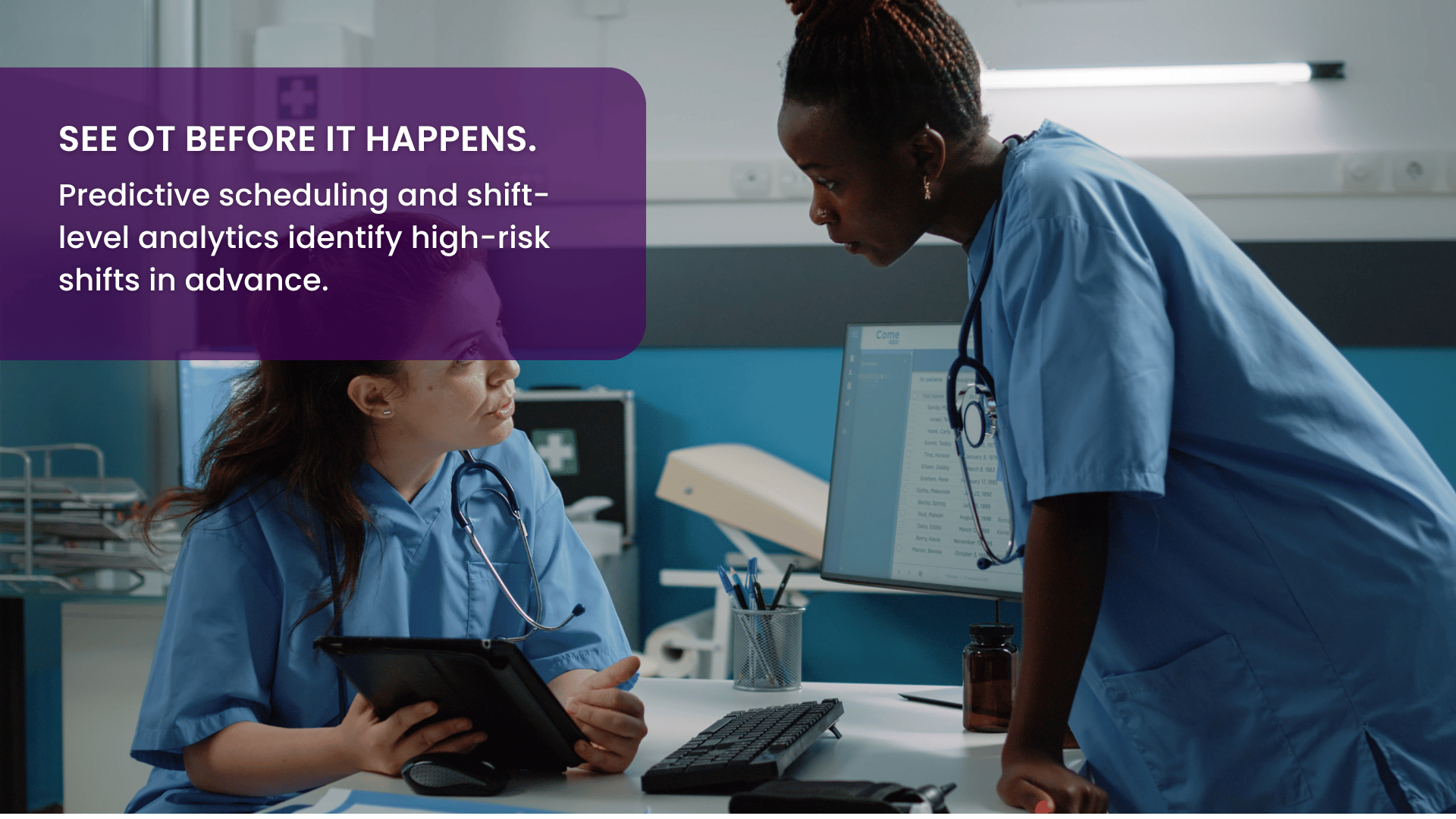
Predictive Scheduling Prevents Overtime Before It Happens
Predictive scheduling turns overtime from a surprise expense into a strategic tool. By analyzing historical OT trends, patient volumes, and unit-specific needs, leaders can anticipate workforce gaps before they become crises.
How it works:
Forecast demand: Identify shifts likely to experience high OT using historical data and patient volume projections.
Adjust scheduling proactively: Reassign float nurses, call per diem clinicians, or redistribute skill mix to prevent coverage gaps.
Reduce costs and burnout: Minimize premium pay while protecting nurse well-being and patient care quality.
Using Shift-Level Analytics to Align Labor With Demand
Shift-level analytics provide granular insight into OT patterns by shift, unit, and role. Instead of reacting to workforce issues after the fact, leaders can see exactly where gaps exist and act proactively.
Benefits for the C-Suite:
Detect recurring OT spikes and coverage gaps early.
Optimize labor allocation in real-time based on patient census and acuity.
Reduce nurse burnout, improve patient care, and keep labor costs in check.

Overtime Insights: FAQs for Hospital Leadership
Overtime isn’t just a staffing metric—it’s a signal of where your workforce may be out of sync with patient demand. The questions below highlight the patterns, causes, and solutions that hospital leaders need to understand to protect margins, support nurses, and maintain high-quality care.
1. Why is nurse overtime so high?
OT spikes when staffing gaps, unplanned absences, high patient volumes, or uneven skill distribution force nurses to work extra hours.
2. What does overtime say about staffing?
Frequent OT highlights mismatches between available staff and patient demand—a clear signal of workforce misalignment.
3. Is overtime a sign of understaffing in hospitals?
Often yes, but not always. Temporary surges can cause OT even in well-staffed units. Tracking trends reveals whether OT is a chronic issue.
4. How can hospitals reduce nurse overtime?
Predictive scheduling, flexible staffing, and shift-level analytics allow leaders to anticipate gaps and prevent OT before it occurs.
5. How do hospitals predict workforce needs?
By combining historical data, patient volume projections, and workforce analytics tools, hospitals can forecast coverage needs and optimize schedules.
6. What is predictive scheduling in healthcare?
A proactive scheduling strategy that aligns nurse shifts with forecasted patient demand, preventing OT and improving staff satisfaction.
7. How does predictive analytics reduce overtime?
Analytics identify high-risk shifts, enabling leaders to proactively reallocate workers or schedule coverage.
8. How can nurse leaders prevent overtime spikes?
Monitor OT metrics, forecast patient demand, and leverage flexible staffing to maintain alignment across shifts and units.
9. How do you identify workforce misalignment in hospitals?
Key indicators include frequent OT, reliance on contract workers, uneven skill distribution, and reactive scheduling practices.
Conclusion: From Overtime Signals to Workforce Strategy
When leaders pay attention, nurse overtime reveals workforce misalignments, showing where gaps are forming and where proactive action can have the greatest impact on patient care, nurse well-being, and hospital margins.
The hospitals that succeed are the ones that anticipate OT rather than react to it. By combining predictive scheduling with shift-level analytics, leaders can turn overtime from a costly problem into actionable insight, keeping units fully staffed, nurses supported, and budgets under control.
Ready to turn overtime into opportunity?
With ShiftMed, hospital leaders gain real-time access to local, credentialed clinicians and powerful workforce insights—so you can flex your workforce, reduce OT, and stay ahead of demand.
Request a demo today and see how ShiftMed helps hospitals work smarter, not harder.