Holiday Nurse Staffing: How to Plan PTO Before the Rush


Every nurse leader knows the moment. By early November, PTO requests are stacking up and the weeks everyone wants off are already oversubscribed. Holiday nurse staffing problems usually trace back to timing. When planning starts late, requests have already turned into expectations by the time managers review them.
Holiday coverage decisions also shape retention. According to the National Council of State Boards of Nursing's 2024 workforce study, more than 138,000 nurses have left the workforce since 2022, and nearly 40% say they intend to leave or retire by 2029.
A Health Affairs Scholar study, highlighted by the NYU Rory Meyers College of Nursing, found that 28.7% of RNs surveyed had left their jobs in the past year, with each departure costing an estimated $45,100 to $67,500 to replace.
Your holiday scheduling shows how fairly your organization treats its staff. Missteps in December can surface as resignations in January. Proactive PTO planning gives leaders a structured process for the weeks ahead and a repeatable one for next year.
Start Holiday PTO Planning Early
Whether you're finalizing this year's holiday schedule or already looking at next year, early planning shapes every decision that follows. Kelley Strandberg, VP of Nursing and Workforce Innovation at ShiftMed, recommends planning for seasonal demand "at least six months in advance, if not earlier." If you’re reading this article in November, the steps below still apply on a shorter timeline, and they set up a June start for next year's plan.
Set a Firm Request Deadline
If holiday requests are still open, set a close date within the next week. A clear cutoff means every request submitted within the window is evaluated by the same rules, regardless of when it arrived. Next year, open the window in early September and close it by October 1.
Review Historical Staffing Patterns
Pull census, acuity, call-out, and overtime data from the last two to three holiday seasons. Look for the shifts where coverage broke down. Christmas Eve nights and New Year's Eve are common pressure points, and your own data may reveal others.
Identify High-Risk Units and Shifts
Strandberg points out that winter brings respiratory surges and busier pediatric floors, and emergency departments feel the same pressure while some elective surgical services slow down. Flag units with high vacancy rates or a large share of newer nurses. A few approved requests on those units can leave shifts short, so plan backup coverage there first.
Create a Fair and Transparent Holiday Scheduling Policy
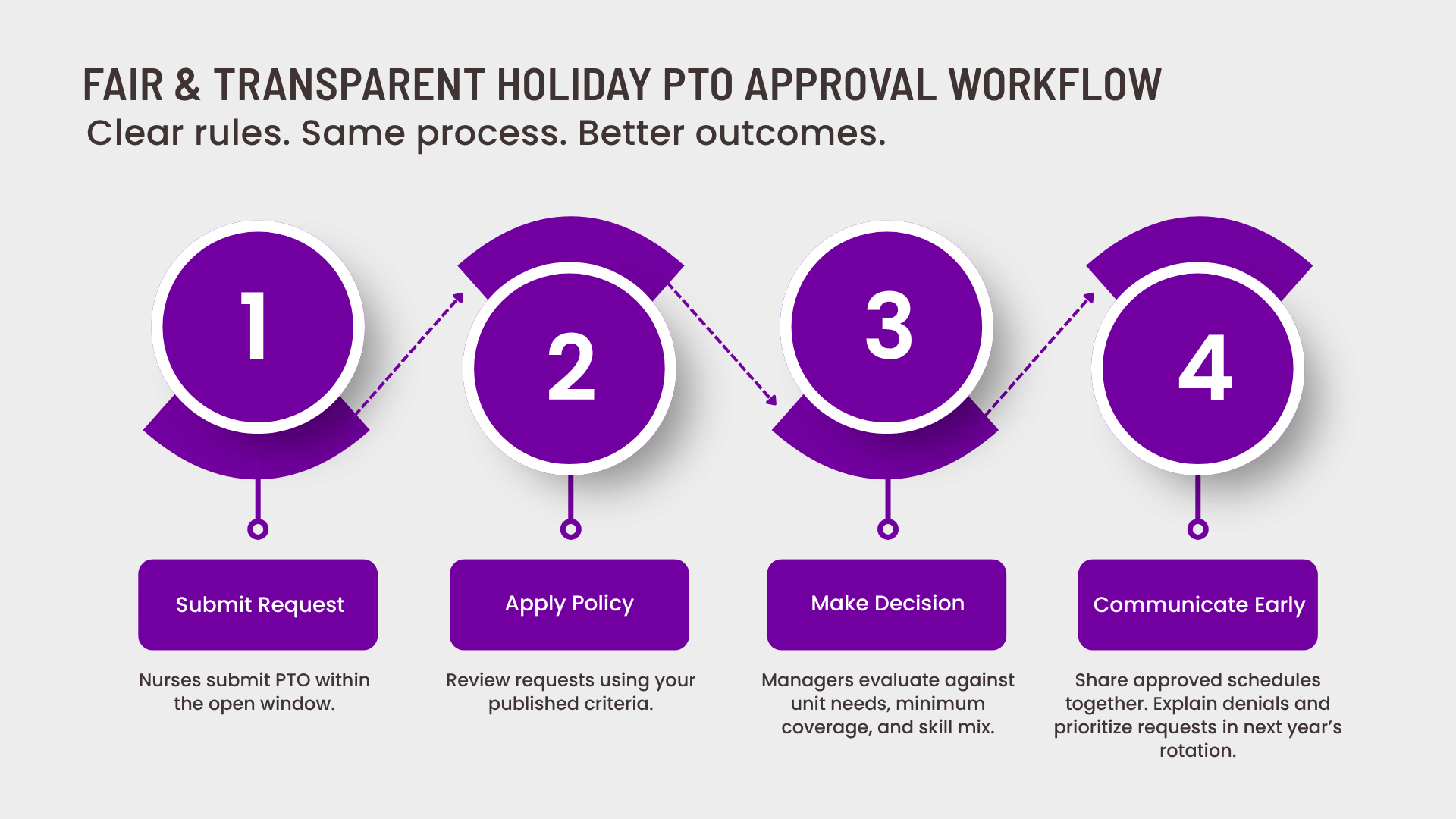
Nurses are more likely to accept a denied request when they understand how the decision was made. A written holiday scheduling policy gives every nurse the same rules and the same timeline.
Use a Holiday Rotation
Many organizations split holidays into groups, such as Thanksgiving and New Year's in one group and Christmas Eve and Christmas Day in another. Nurses who work one group this year get priority for the other next year. Track it so the rotation carries over even when managers change.
Define Approval Criteria in Advance
Decide how you'll weigh seniority, prior holiday worked, request date, and documented hardship, then publish the order. Avoid adding new criteria mid-season.
Apply It Consistently Across Units
When one unit honors seniority and the unit next door uses first-come, first-served, nurses notice. Consistency also matters in HR, since uneven practices can create risks to employee relations and contract compliance.
Clear policies give nurses more control over their time off. In McKinsey's research on nurse retention, surveyed RNs ranked control over their time off and schedule as the most important form of flexibility.
Strandberg connects schedule stability directly to retention. In her experience, many nurses who leave are leaving environments where scheduling feels chaotic and unpredictable. "When workforce management is done well, flexibility actually improves stability," she says.
Balance Nurse Time-Off Requests With Safe Staffing Coverage
Every approved PTO request changes the assignments of the nurses who stay. Research led by Linda Aiken at the University of Pennsylvania, published in JAMA, found that each additional patient per nurse was associated with a 7% higher risk of surgical patient death. Holiday coverage gaps, therefore, carry patient safety risks along with morale costs.
Start With Minimum Coverage
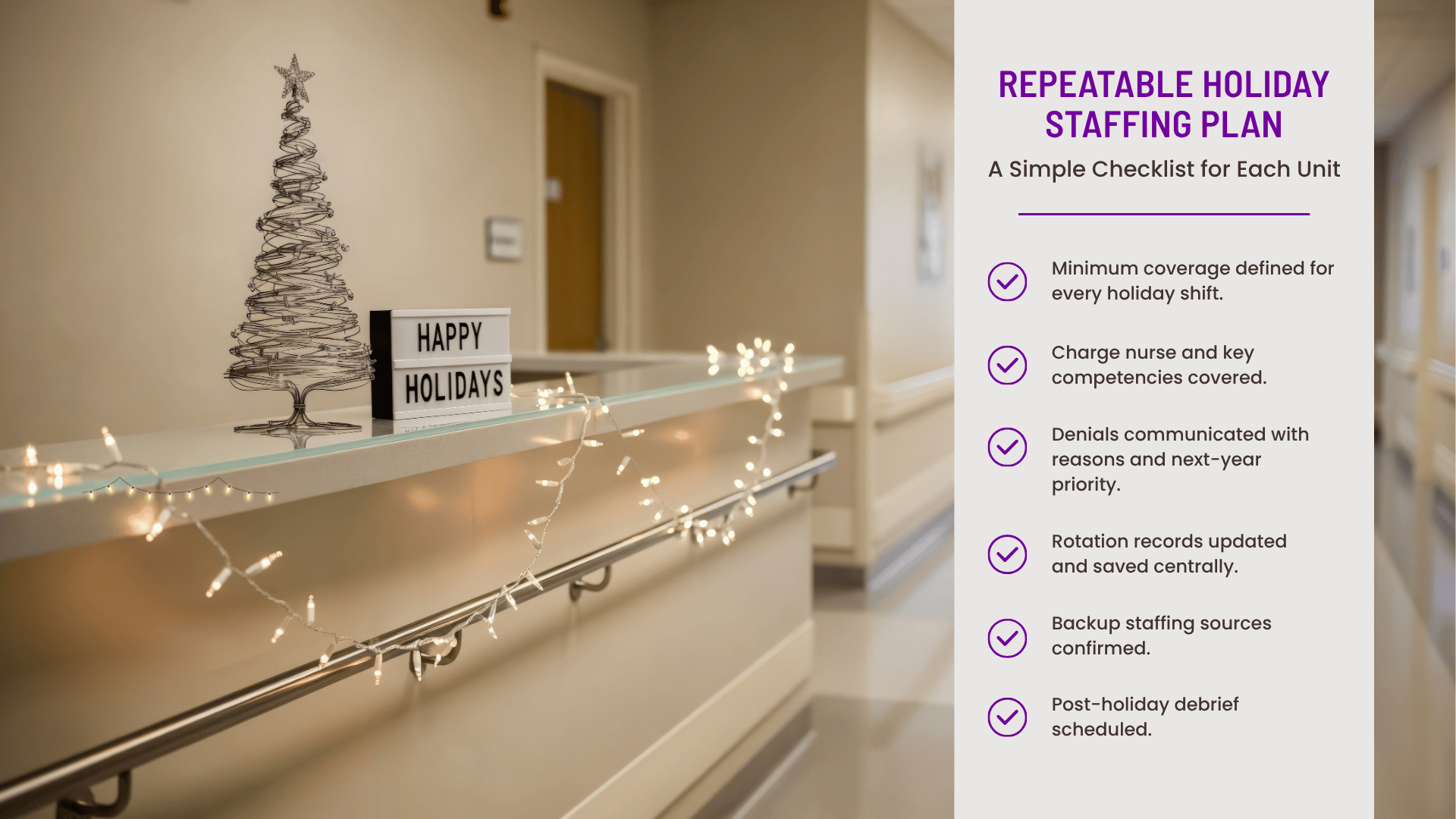
Define the floor for each unit and shift based on expected census and acuity, as well as any state or contractual ratio requirements. Approve PTO only up to the point where that floor stays intact.
Protect Your Skill Mix
Headcount alone can hide gaps in experience. Make sure every holiday shift includes an experienced charge nurse and nurses with the specialty competencies the unit needs, such as rapid response management.
Forecast Anticipated Demand
Base the plan on projected holiday demand using prior-year holiday data, and plan for the census climb that often follows New Year's Day.
Set an Internal-First Escalation Order
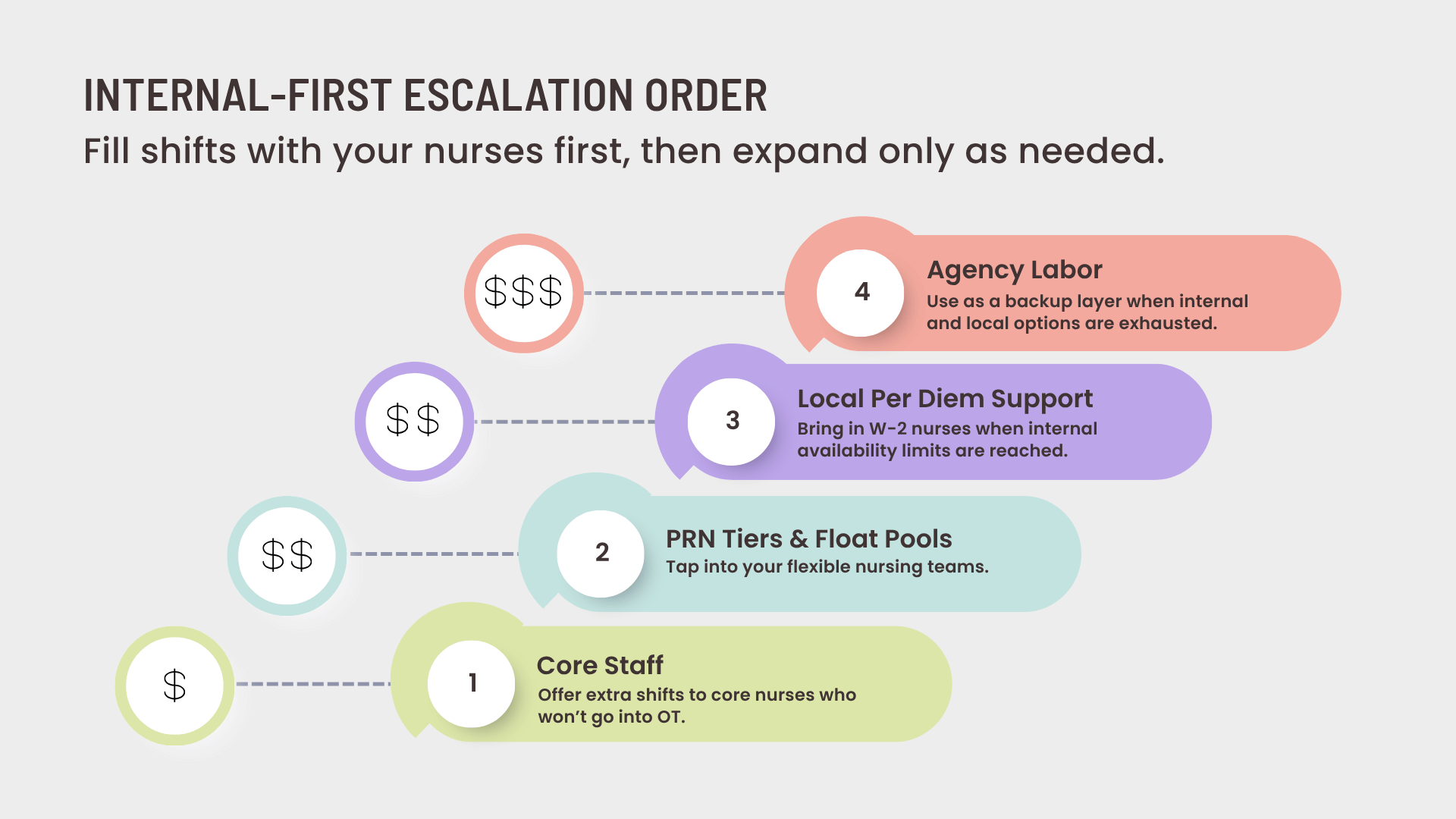
Strandberg sees the strongest health systems follow a consistent sequence. They offer extra shifts to their own staff first, then turn to float pools and PRN teams, then to trusted community-based clinicians, with agency labor as the last resort. Writing the order down gives managers a clear plan at 5 a.m. on December 25 and keeps incentive pay from climbing shift by shift.
Watch for Early Warning Signs
"Frontline staff know almost immediately," Strandberg says. Overtime and incentive offers start creeping up, and managers take patient assignments more often. Those signals usually appear well before quality metrics reflect the strain.
Communicate Holiday PTO Decisions Early
Nurses need time to arrange travel and childcare. A decision that arrives on December 1 forces them to plan around uncertainty, and that uncertainty breeds frustration.
Commit to a publication date and meet it. For this season, publish schedules as soon as requests close. Next year, aim for mid-October. Share approved schedules for all units at the same time so no one hears the news secondhand. When a request is denied, explain which criteria applied and when that nurse will receive priority under the rotation.
Predictable timelines also reduce the perception of favoritism. When nurses can see the rules and the outcome, they're less likely to assume decisions were made behind closed doors. Nurses who view the process as fair are also more willing to pick up an extra shift when a colleague calls out.
Build a Repeatable Holiday Staffing Plan
A documented process lets nurse managers repeat the plan each year with less effort. For this season, focus on the November and January steps below, then start the full cycle in June. Here is a sample timeline you can adapt:
June to July: Review last year's holiday census and overtime data. Confirm the holiday rotation list and update the written policy.
Early September: Announce the PTO request window, deadline, and approval criteria to all staff.
October 1: Close requests. Managers review against minimum coverage and skill mix.
Mid-October: Publish approved holiday schedules across all units at once. Post open shifts and incentive opportunities.
November: Confirm float pool and per diem coverage. Finalize escalation contacts for each holiday.
January: Debrief. Capture coverage gaps and nurse feedback on the process.
How Centralized Scheduling Helps Manage Competing Requests
Holiday policies are hard to apply consistently when requests live in spreadsheets. As health systems grow, holiday scheduling for nurses becomes a system-wide coordination task.
Centralized scheduling keeps requests and open shifts in one place, so managers and nurses work from the same information.
Workforce visibility shows CNOs staffing across every care setting, from urgent care clinics to ambulatory surgery centers. Outpatient volume often dips over the holidays while inpatient units stay full. Leaders who see both can plan cross-site moves weeks ahead, before options shrink on the day of the shift.
Enterprise redeployment lets a health system move two nurses from a quiet surgery center to a short-staffed med-surg unit. ShiftMed carries the correct billing and check-in codes for each move. UKG stays the system of record for time, and nurses check in on the ShiftMed app, which posts their hours to the right journal entries.
Strandberg says real-time integrations should update coverage the moment someone picks up a shift or calls off. "The best workforce technology should quietly remove burden in the background," she says.
Standardized approval workflows automatically apply your rotation rules and provide HR with an audit trail. Flexible scheduling also supports retention. A McKinsey and American Nurses Foundation survey found almost one-third of nurses get no scheduling flexibility from their employer, and McKinsey's follow-up analysis ranks schedule flexibility as the top reason retired nurses would return to the bedside.
Plan Now, Protect Your Team Later
Ultimately, holiday nurse staffing involves trade-offs. Proactive PTO planning with clear rules lets nurses see how decisions are made and plan their holidays with confidence. As Strandberg puts it, "A well-supported shift feels stable." Looking ahead, a repeatable process gives your organization a stronger start each January.
Ready to bring more structure to your holiday staffing plan? Talk with ShiftMed about centralized scheduling and flexible coverage for your units.