The Big Shift: Why Leading Health Systems Are Rebuilding the Workforce Operating Model


The 2026 Transformation Summit, powered by ShiftMed at Raymond James Stadium, delivered a clear message: Current workforce challenges are making health system overhauls not just about staffing but also about core workforce operations.
Speakers, health system executives, workforce leaders, and technology partners agreed: traditional hospital workforce management no longer meets the demands of today’s complex healthcare environment.
Margins are tighter, labor pressure persists, and patient demand continues to grow. Clinician expectations for flexibility and scheduling have changed dramatically. Still, many organizations use disconnected systems, siloed decisions, and manual processes that hinder team adaptation.
The Summit became a wide-ranging discussion of rethinking workforce strategy as the key to operational transformation.
What does a fragmented workforce actually cost? The Coordination Gap white paper, built on findings from the Transformation Summit, breaks down where the money goes and how leading health systems are closing the gap. Download it here.
Healthcare Is Moving From Unit Optimization to System Optimization
A main theme across the Summit was that health systems must stop managing workforce operations by unit. For years, workforce management has occurred in departmental silos where:
Individual nurse managers oversee schedules independently.
Separate staffing offices operate without enterprise visibility.
HR, nursing, and operations make disconnected decisions.
Float pools serve as reactive backups rather than strategic capacity.
It’s an approach that’s becoming increasingly difficult to sustain under modern healthcare demands.
Health system leaders are moving toward centralized workforce strategies, treating labor as an enterprise resource, with real-time visibility, shared accountability, and dynamic labor distribution.
Real-time visibility across facilities.
Shared accountability for staffing decisions.
Dynamic redistribution of labor based on demand.
Standardized scheduling practices across the organization.
Centralized workforce operations command centers.
System-level workforce marketplaces that improve flexibility and fill rates.
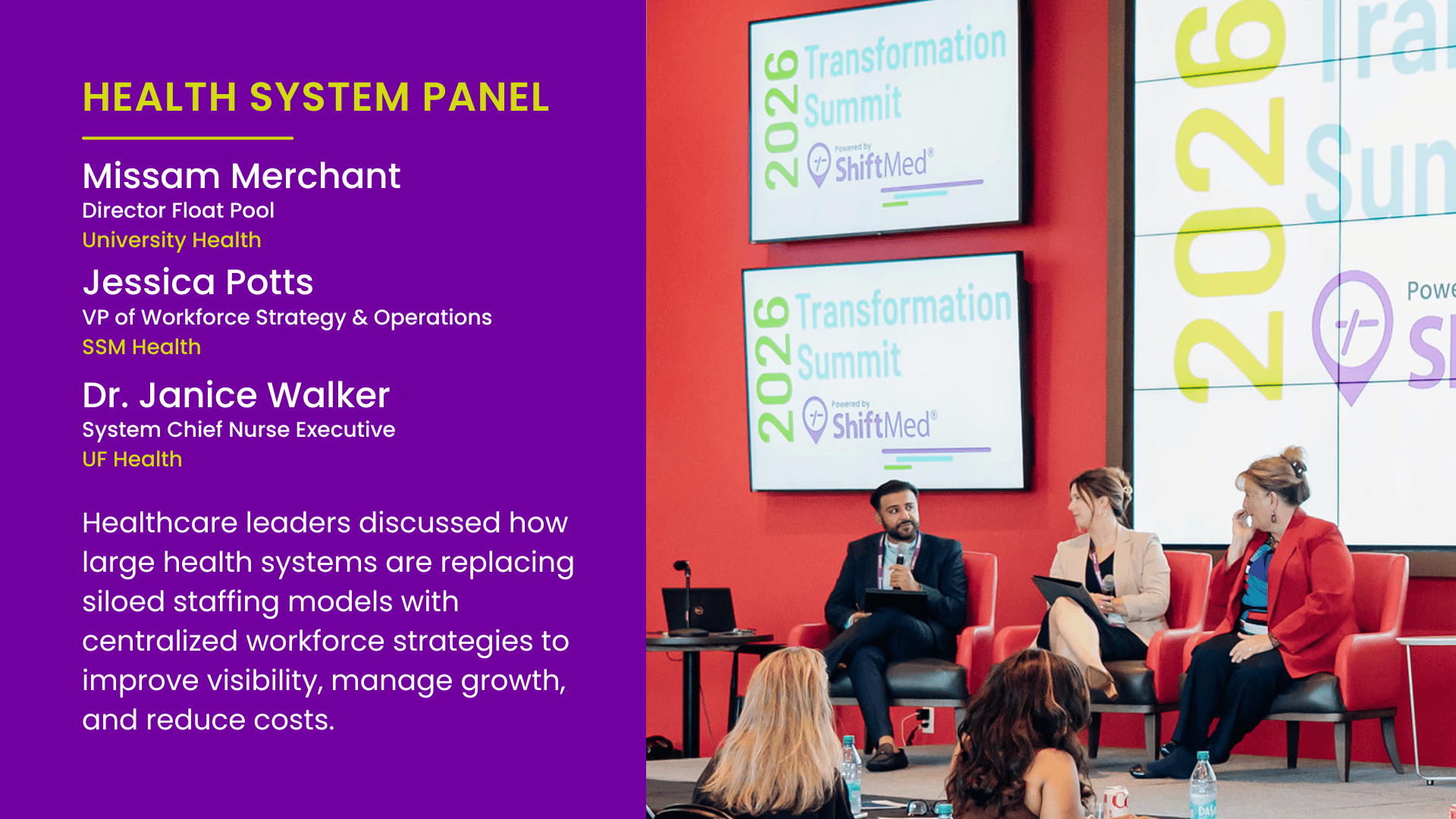
Healthcare Workforce Flexibility Is a Strategic Imperative
Health systems increasingly find their labor challenges stem from misaligned workforce models, not clinician supply.
Executives emphasized that clinicians seek more schedule control and flexibility, often valuing it more than compensation.
Flexibility now drives many retention decisions.
Gen Z nurses expect entirely different workforce experiences.
Traditional full-time models no longer fit many workers.
Organizations that redesign their labor models for today’s realities will achieve lasting workforce stability. These redesigns include:
Internal workforce marketplaces.
Flexible shift-based staffing.
Cross-facility float strategies.
Open shift technology.
Dynamic incentive models.
PRN optimization.
Real-time labor deployment.
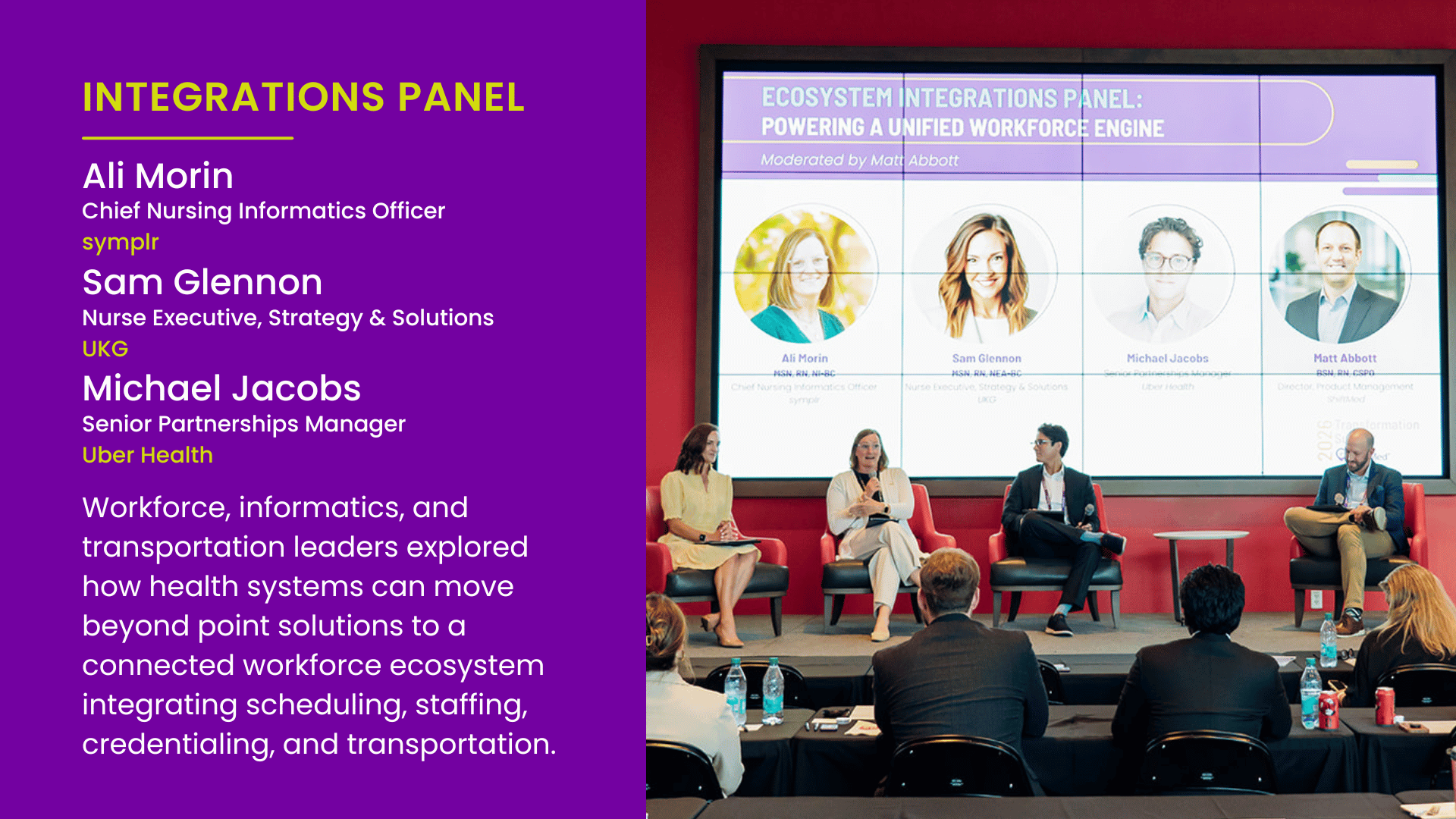
Workforce Coordination in Healthcare Is a Challenge
Workforce coordination was another main Summit topic, highlighting how many labor challenges result from system, process, and data fragmentation.
Executives described environments where:
Staffing decisions happen in isolation.
Workforce data lives across spreadsheets, texts, emails, and disconnected systems.
HR lacks visibility into operational demand.
Nurse managers spend most of their time filling gaps rather than leading teams.
Internal labor capacity exists but doesn’t surface fast enough.
This insight reframes the entire conversation. When workforce systems operate independently, health systems lose the ability to:
Predict staffing risk with confidence.
Share and deploy labor across facilities.
Fully leverage internal workforce capacity.
Reduce reliance on premium labor spend.
Make more equitable, consistent staffing decisions.
Move from reactive coverage to proactive workforce planning.
In response, many organizations are now working toward a connected workforce ecosystem, integrating scheduling, credentialing, HR systems, workforce marketplaces, and even transportation into a more unified operating model.
Real-Time Data Is Becoming Workforce Infrastructure
Another executive takeaway was that real workforce transformation requires trusted, real-time data.
Healthcare leaders now see that without real-time, accurate data, advanced workforce strategies fail at execution. Real-time visibility is now essential infrastructure for decision-making.
In the absence of it, organizations struggle to:
Respond quickly to shifting patient demand and staffing needs.
Identify and redeploy available internal capacity in real time.
Reduce lag between workforce gaps and coverage decisions.
Align operational leaders and HR around a single source of truth.
Make confident, data-driven workforce decisions at scale.
As a result, many health systems are beginning to treat real-time workforce data as foundational infrastructure on par with scheduling, credentialing, and HR systems.
AI Will Reshape Workforce Management (But Human Leadership Still Wins)
AI was woven throughout nearly every conversation at the Summit, but notably, the tone was far more practical than hype driven. Speakers consistently emphasized that AI’s biggest opportunity in healthcare may not be replacing clinicians but reducing operational friction via:
Predictive staffing models.
Intelligent scheduling.
Automated workforce matching.
Demand forecasting.
Administrative burden reduction.
Workforce coordination at scale.
But there was also a strong acknowledgment that AI only works if the underlying systems and data are connected. Fragmented workflows limit AI effectiveness, while unified ecosystems enable it.
At the same time, several speakers reinforced an equally important truth: as healthcare becomes more automated, human-centered leadership becomes more essential—not less.
Themes of trust, empathy, communication, transparency, shared governance, and frontline engagement surfaced repeatedly throughout the discussions. Because ultimately, workforce transformation is still fundamentally a change management challenge.
And no technology platform can replace the role of leaders who build alignment, foster trust, and drive adaptability across complex healthcare organizations.
An Enterprise-Wide, Flexible, and Connected Workforce Model Is Emerging in Healthcare
The Transformation Summit showed that workforce management in healthcare is now a core enterprise strategy.
Leading organizations centralize workforce visibility, break silos, create integrated ecosystems, leverage AI, treat labor as a flexible resource, and invest in proactive management infrastructure.
This shift is a fundamental redesign of workforce deployment and capacity management. Success will belong to health systems with the most connected workforce, not necessarily the largest staff.
Download the Workforce Instability Is a Design Problem playbook that attendees received at the Summit to learn how leading health systems are redesigning workforce structures for long-term success. We also recommend reading our guide to healthcare workforce optimization.